The fabric touching your skin during intimacy isn’t decoration — it’s a direct input into how pleasure registers, how your skin responds, and how well your body’s natural barrier holds up under sustained contact.
The best lingerie fabric isn’t the prettiest one — it’s the one that works with your body, not against it.
Most people choose lingerie for how it looks. That’s a reasonable starting point, but it stops well short of the full picture. When high-tech intimacy devices enter the equation — vibrating wearables, app-connected stimulators, temperature-responsive tools — fabric selection becomes a functional decision with real consequences. The material pressed against your skin for extended periods affects circulation, moisture regulation, friction levels, and skin integrity.
“Fabric is the first interface between a device and the body — choose it carelessly, and even the most sophisticated technology works against itself.”
Sensory feedback starts at the skin. The nerve-dense regions most relevant to intimate wear are extraordinarily sensitive to texture, temperature, and pressure. A coarse or synthetic fabric can trigger low-grade irritation that competes with intended sensation — essentially introducing noise into a signal. Natural fibers respond differently, conforming to the body rather than resisting it.
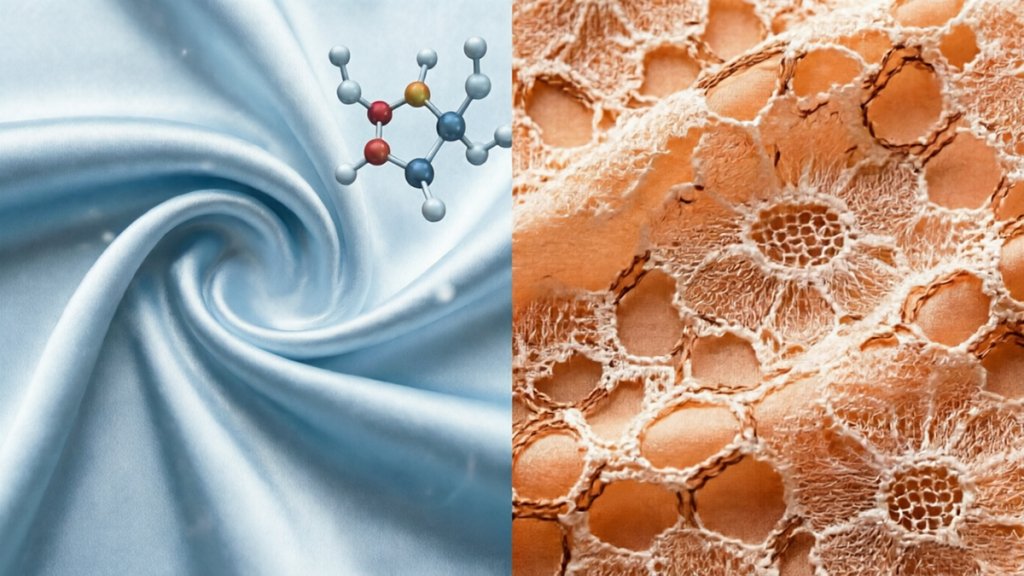
Lace is the cultural default for intimate wear — beautiful, layered, evocative. But structurally, it’s an open-weave fabric with irregular surface contact, rough thread intersections, and minimal moisture management. Against sensitive skin, or pressed between a device and the body, those qualities shift from aesthetic features to functional liabilities.
Silk operates on an entirely different level. High-grade silk is biocompatible with human skin, making it especially relevant for sensitive areas and extended wear. Understanding why that’s true — the actual science behind silk’s performance — is where the comparison gets genuinely interesting. And it starts at the molecular level.

The Science of Silk: More Than Just a Smooth Finish
Silk’s advantage in the silk vs lace lingerie conversation isn’t purely aesthetic — it’s biochemical, structural, and deeply skin-compatible in ways synthetic alternatives simply can’t replicate.
Mulberry silk is, at its core, a bioactive material. According to Healthline and Dermatology Times, mulberry silk contains 18 essential amino acids and natural proteins that actively promote skin hydration. This isn’t passive softness — the fiber interacts with your skin’s moisture barrier, supporting cellular regeneration at a level no synthetic weave can match. For anyone with skin prone to sensitivity, this distinction is meaningful.
Thermal regulation is another underappreciated biological advantage. As noted by textile researchers cited on NCBI, “silk is a natural heat regulator, helping the body maintain a comfortable temperature.” The fiber’s hollow core structure traps or releases heat depending on ambient conditions — keeping you cool during summer and insulating effectively in colder months. In practice, this means your body isn’t fighting discomfort from overheating or chill, which directly affects how sensation is processed.
Here’s a breakdown of silk’s biological benefits:
- Amino acid content: 18 essential amino acids that bond with skin proteins and support hydration
- Cellular support: Natural sericin protein encourages skin cell regeneration over time
- Temperature balance: Adaptive thermal regulation for year-round comfort
- Hypoallergenic properties: Natural silk fibers resist dust mites, mold, and common allergens
- Moisture management: Wicks humidity without stripping the skin’s natural oils
Hypoallergenicity rounds out silk’s credentials. Unlike synthetic fabrics that often rely on chemical treatments, natural silk fibers are inherently resistant to common irritants. This makes silk a strong default for sensitive skin — a quality worth keeping in mind as we explore how lace behaves very differently against the body.
The Intricacy of Lace: Visual Allure vs. Mechanical Friction
Lace commands attention instantly, but choosing the right lingerie fabrics means looking past the visual drama to understand what’s actually happening at a structural level.
The quality of any lace piece is defined by its “hand” — the tactile character produced by thread count, weave density, and fiber composition. At the pinnacle sits Leavers lace, a construction so complex it utilizes over 15,000 individual threads, according to the Victoria & Albert Museum. Each thread is independently controlled to build open, geometrically precise patterns with a supple drape that sits gently against skin.
Leavers lace vs. mass-produced synthetics — the gap between them isn’t cosmetic:
- Leavers lace: Natural or high-grade fibers, consistent tension, soft edges, minimal abrasion risk
- Standard machine lace: Nylon or polyester base, uneven thread loops, stiff finishing, potential for friction points
- Budget synthetic lace: Rough cut edges, chemical finishes, higher likelihood of surface irregularity
That structural difference translates directly into sensation. Where silk delivers a uniform, gliding pressure across skin, quality lace introduces deliberate texture — raised floral motifs, open-weave negative space, and alternating dense-and-light zones. In practice, this creates a layered tactile stimulus that many find visually and physically exciting.
However, the risk lies in the lower tiers of production. Synthetic lace with poor finishing can cause micro-abrasions — tiny surface-level irritations from repeated friction against sensitive skin. This becomes particularly relevant during extended wear or movement-intensive moments. Understanding how fabric interacts with the body during friction-intensive intimate activity underscores why construction quality isn’t optional.
On the other hand, even well-constructed lace raises a separate, often overlooked concern — what happens when moisture enters the equation.
Breathability and Intimate Health: The Moisture Factor
Silk’s superiority in intimate wear comes down to a biological reality: moisture mismanagement in sensitive areas creates real health risks, and fabric choice is the first line of defense.
Silk absorbs up to 30% of its own weight in moisture without ever feeling damp — a benchmark confirmed by the International Sericultural Commission. In practice, that means silk actively wicks perspiration and natural secretions away from the skin’s surface, keeping intimate zones dry, comfortable, and far less hospitable to bacterial and yeast overgrowth. Candida and other opportunistic organisms thrive in warm, humid, poorly ventilated environments. The right fabric disrupts that equation before it starts.
Lace’s structural limitation is the flip side of this story. Despite its open weave, most modern lace is engineered from nylon, polyester, or synthetic blends that trap heat rather than dissipate it. The decorative gaps that make lace visually appealing don’t compensate for the underlying synthetic base layer pressed directly against skin. The result is a microclimate that stays humid longer — precisely the condition that gynecologists and dermatologists consistently flag as problematic for long-term wear.
The silk vs cotton underwear debate often centers on softness, but breathability tells the fuller story. Cotton is absorbent but slow to release moisture, leaving fabric clinging and damp. Silk, by contrast, balances absorption with rapid evaporation, maintaining a drier surface through extended wear. For extended intimate sessions or when pairing lingerie with body-worn accessories — where friction and warmth compound naturally — that distinction becomes clinically meaningful, not just a comfort preference.
Nylon-based alternatives may mimic silk’s sheen, but they lack the protein-fiber structure that enables true moisture regulation. Genuine silk earns its place as the intelligent choice for intimate health, not just intimate aesthetics.
As fabric choices affect more than comfort during casual wear, that distinction becomes even more critical when lingerie is put under the real mechanical stress of high-tech devices — which is exactly where the next conversation begins.
Durability in Motion: Pairing Lingerie with High-Tech Devices
Silk lingerie benefits extend well beyond aesthetics — when paired with motorized intimate devices, fabric performance under mechanical stress becomes a genuine functional concern.
Fabric choice directly determines whether your lingerie survives repeated contact with high-motion devices — or gets destroyed by them.
Friction resistance is where the gap between silk and lace becomes undeniable. Telescoping thrusting mechanisms generate rhythmic, directional force against whatever fabric sits nearby. Silk’s tightly woven, smooth filaments glide under that pressure rather than catching. Lace, by contrast, presents an open lattice of raised fibers — each intersection point a potential snag waiting to happen.
Fabric density plays a critical supporting role, particularly with vibrating attachments that use flapping or oscillating motion. According to Kissself Factory Insights, high-density lace patterns do improve durability against mechanical friction — but this comes at a cost. Denser lace sacrifices the breathability already discussed in earlier sections, while silk maintains both density and moisture management simultaneously.
| Fabric | Device Compatibility | Durability Rating |
|---|---|---|
| Silk | High — smooth surface resists snagging | ★★★★★ |
| High-density Lace | Moderate — better than open lace, but prone to fiber stress | ★★★☆☆ |
| Open-weave Lace | Low — high snag risk with thrusting or oscillating mechanisms | ★★☆☆☆ |
Material quality in factory-direct products matters enormously here. Lower-grade weaves — regardless of fabric type — lose structural integrity faster under repeated mechanical contact, leading to pilling, tearing, or distortion.
Garment integrity during intense activity isn’t vanity — it’s practicality. A garment that warps or snags mid-session interrupts the experience and shortens product lifespan considerably.
This brings up a natural question: if silk outperforms lace and handles mechanical stress more gracefully, where does everyday cotton fit into the picture?
The Cotton Contention: Is Natural Always Better?
Cotton’s reputation as the “safe” fabric choice is well-earned — but it tells only part of the story when comfort, health, and intimacy intersect.
Default to cotton: Most people reach for cotton underwear and loungewear because it’s breathable, affordable, and widely recommended by healthcare providers for daily wear. That reputation is grounded in real benefits — cotton is hypoallergenic, gentle on most skin types, and easy to launder.
However, cotton has a significant drawback that’s often overlooked. According to The Spruce, cotton absorbs moisture but stays damp rather than moving it away from the skin. In intimate contexts, that retained moisture becomes a liability — creating warmth and conditions that sensitive skin doesn’t need.
Silk as a luxury upgrade: This is where silk earns its place. It delivers the same natural-fiber gentleness cotton is celebrated for, while actively wicking moisture rather than holding it. For anyone asking is lace or silk better for skin on an ongoing basis, silk is the clear answer — it maintains cotton’s health advantages without the dampness problem. Exploring sensory fabric options during intimate moments reinforces just how much material choice shapes the overall experience.
Lace’s role: Lace, by contrast, is a short-game fabric. It offers unmatched visual appeal and a tactile edge that works powerfully for aesthetic-driven moments — but it doesn’t compete with either cotton or silk on sustained wear or moisture management.
When to Wear: Quick Reference
- Cotton → Everyday utility, post-intimacy recovery, medical recommendations
- Silk → All-day comfort, high-tech device pairing, sustained intimate wear
- Lace → Short sessions, visual presentation, layered over silk for effect
Knowing when each fabric earns its place is only half the decision. The other half is knowing how to identify quality — which is exactly what choosing the right piece comes down to next.
Choosing Your Signature Style: A Fabric Selection Guide
Selecting intimate apparel that genuinely works for your body and lifestyle comes down to four practical factors: sensitivity, activity, silk quality, and lace construction.
The right fabric isn’t just about looks — it’s a health and performance decision.
Use this checklist before your next purchase:
- Assess your skin sensitivity first. If you experience redness, itching, or irritation after wearing synthetic blends, prioritize natural fibers. Silk’s protein-based structure is inherently hypoallergenic and far less likely to trigger reactions than nylon-heavy lace. When browsing lingerie and intimate apparel options, filter by material composition before evaluating style.
- Match fabric to the intended activity. As covered in earlier sections, silk’s smooth, low-friction surface performs significantly better alongside motorized devices. For relaxed loungewear or aesthetic-focused occasions, lace remains a compelling choice — but if high-tech play is on the agenda, silk is the practical pick.
- Identify quality silk through momme weight and luster. According to the SilkSilky Quality Guide, high-quality silk is measured in momme weight — the higher the momme (typically 19–25mm for intimate wear), the denser and more durable the fabric. Look for a consistent, subtle sheen rather than a plastic-like gloss, which typically signals synthetic blending.
- Evaluate lace by softness and thread density. Run the fabric across your inner wrist. Coarse, scratchy lace will feel worse against more sensitive skin. Tightly woven lace with smooth finishing edges causes far less irritation than loose, open-weave alternatives.
In practice, the smartest approach is building a wardrobe with both — silk for health-conscious, device-paired experiences and lace for visual occasions. Understanding these distinctions makes the final comparison between the two fabrics much clearer.
The Bottom Line: Silk vs. Lace Summary
When it comes to intimacy, fabric choice is never trivial — silk and lace each win decisively in different categories, and knowing which is which changes everything.
Here’s where each material clearly leads:
- Skin health and thermal regulation: Silk wins outright. Its naturally protein-rich structure — built from 18 amino acids that offer a genuine biological advantage over synthetic alternatives — keeps skin cool, dry, and irritation-free during prolonged wear.
- Visual appeal and tactile variety: Lace wins. Its open weave, intricate patterning, and rich textural contrast create visual complexity that silk’s smooth surface simply can’t replicate.
- Compatibility with high-performance devices: Silk wins again. Where lace fibers can snag, bunch, or create uneven pressure points against vibrating or mechanically active devices, silk’s fluid surface allows consistent, uninterrupted contact. For anyone exploring how functional tech and intimacy intersect, fabric behavior under dynamic conditions matters more than most people expect.
- Intimate health support: Natural, breathable fibers like silk are the clear recommendation. Lace — particularly synthetic versions — traps heat and restricts airflow, conditions that dermatologists and gynecologists consistently flag as problematic for sensitive skin and vaginal health.
The most important takeaway: choose silk when performance matters, lace when presentation does.
In practice, the two aren’t mutually exclusive. Many well-designed pieces layer lace as an outer aesthetic element over a silk or silk-blend lining — capturing visual drama without sacrificing skin-level comfort. That layered approach reflects a broader shift toward intimacy wear that works as hard as it looks.
Still have specific questions about material choices for your situation? The answers to the most common ones are coming up next.
Frequently Asked Questions About Lingerie Materials
Choosing between silk and lace isn’t just a style decision — it shapes comfort, compatibility, and longevity in ways most shoppers don’t consider until something goes wrong.
Is silk or lace better for sensitive skin?
Silk is the clear winner for sensitive skin. Its naturally smooth, protein-based fibers create minimal friction and rarely trigger irritation, making it a go-to choice for anyone prone to redness or discomfort. If you need additional reassurance, pairing silk with a hypoallergenic intimate lubricant adds another layer of protection.
Can I wear lace lingerie with a vibrator?
Yes, but with caveats. Lace’s open-weave structure transmits vibration effectively, which many people find enhances sensation during play. However, rough lace edges can cause chafing during extended sessions, so opting for softer, stretch-lace blends reduces that risk considerably.
How do I wash silk vs. lace to ensure they last?
Both materials demand gentle hand-washing to preserve their fiber integrity — a standard recommended by textile conservators at the Victoria & Albert Museum. Use cool water and a mild, pH-neutral detergent, and never wring either fabric. Lay flat to dry away from direct heat or sunlight to prevent weakening the fibers.
Why is silk more expensive than lace?
Silk’s price reflects the complexity of its production. Harvesting and processing silk filaments from silkworm cocoons is labor-intensive and yields a limited volume of fabric. Lace, by contrast, is largely machine-produced today, driving costs down significantly. In practice, that price gap directly mirrors the difference in performance, durability, and skin feel you experience while wearing each material.