Buying a vibrating strap-on dildo can feel like a lot—because it is a lot. Comfort, stability, size, materials, and cleaning all matter, and the right choice looks different depending on your body, your sensitivity, and whether you’re using it solo or with a partner.
This guide gives you a calm, practical evaluation framework you can use for any product in this category. Then, as a real-world example, we’ll map that framework to Vibrating Clitoral Strap Dildo Rabbit Ear 6.53 In.
Key Takeaway: The “best” option is the one that fits your comfort level, stays stable during movement, and is easy to keep clean—not the one with the longest feature list.
What “rabbit ear” means—and why some people prefer it
A “rabbit ear” design refers to a pair of soft, ear-like extensions meant to provide external stimulation (typically clitoral stimulation) at the same time as internal use. Think of it as a blended-experience design: you’re not choosing between one type of sensation or another.
If you already know you prefer external stimulation—or you want a more “all-in-one” feel—a rabbit ear design can be the difference between “nice in theory” and “actually reaches what I need.”
In this buyer’s guide, you’ll also see the phrase rabbit ear vibrator used as a search term people commonly type. The important part is not the nickname—it’s whether the external stimulator aligns comfortably for you.
How to choose a vibrating strap-on dildo: a simple decision framework
If you want a clean, no-drama way to decide, evaluate in this order:
- Fit + stability (will it stay where you want it?)
- Size (especially diameter)
- Adjustability (how much control you have over alignment)
- Vibration control (range, sensitivity, and easy settings)
- Water resistance + cleaning reality
- Noise + discretion
Why this order? Because a product can have incredible vibration features, but if it slips, pinches, or doesn’t align with your anatomy, you won’t use it.
The 6 criteria that matter most (with plain-English explanations)
1) Fit stability: the “no slipping” factor
A strap-on can have great features and still disappoint if it shifts, twists, or loses contact. Stability usually comes down to:
- How it’s secured (strap tension and design)
- Balance (weight distribution; top-heavy designs can pull or rotate)
- Your movement style (some people need extra stability for dynamic positions)
What to look for on a product page
- Any mention of “stays in place,” “no slipping,” or “fits various positions” should be supported by design details (adjustability, balance, etc.).
Example: The listing for Vibrating Clitoral Strap Dildo Rabbit Ear 6.53 In claims it “fits any position without awkward slipping,” and emphasizes a design intended to stay stable.
2) Adjustability: more control, less frustration
If you’re shopping for an adjustable strap-on, you’re already thinking about the right question: “Can I align this to my body?”
Adjustability can mean:
- Angle adjustment (tilt forward/back)
- Rotating heads or repositionable segments
- Flexible joints that hold a set position
Example: This product’s page states the dual heads are 180° adjustable, which should make it easier to dial in contact points.
3) Size: beginner-friendly isn’t just “short”—it’s proportional
“Beginner-friendly” is often used loosely, so use numbers instead.
The two measurements that most affect comfort:
- Diameter (often more important than length)
- Insertable length
Example specs (from the product page):
- Insertable length: 6.1 in
- Insertable diameter: 1.38 in
That size range is commonly considered approachable for many people—especially if you’re stepping up gradually. If you’re specifically looking for a beginner-friendly strap-on, this kind of transparent sizing is what you want to see.
4) Vibration: variety is only helpful if control is easy
A big number of settings isn’t automatically better. What matters is whether you can quickly find the level that matches your sensitivity.
Example: This product lists 9 frequencies.
A practical way to think about modes:
- Lower settings help if you’re sensitive
- Mid settings are often the “everyday” default
- Higher settings are optional—nice to have, not mandatory
5) Water resistance and cleanup: what IPX6 actually signals
This model is rated IPX6. IP ratings come from the Ingress Protection (IP) code; IPX6 generally means protection against powerful water jets (per the IP code overview on Wikipedia). In everyday terms, an IPX6 rating can make cleanup easier because the device is built to handle strong rinsing and splashes.
A useful distinction:
- “Water-resistant” or “IP-rated” often supports easier cleaning.
- It doesn’t automatically mean “safe to submerge for long periods.” (Always follow the included manual.)
If you’re searching for a waterproof vibrating strap-on, look for a real rating (like IPX6) rather than a vague “waterproof” claim.
6) Noise and discretion: how to interpret “<60 dB”
This listing claims noise is <60 dB.
A “dB” (decibel) is a logarithmic unit used to express a ratio (see Wikipedia’s decibel overview). A single number without test conditions can’t tell you everything, but it’s still useful for comparison—especially if discretion matters.
If you’re noise-sensitive, your best move is to pick a model with:
- Multiple intensity options (so you can stay on a lower setting)
- A stable fit (rattling and shifting can increase perceived noise)
Quick spec sheet: the facts in one place
| Spec | Value (from product page) | Why it matters |
|---|---|---|
| Materials | Silicone + ABS | Comfort, structure, care requirements |
| Overall size | 12.99 × 4.13 in | Helps you picture scale and storage |
| Insertable length | 6.1 in | Comfort + fit planning |
| Insertable diameter | 1.38 in | Often the biggest comfort variable |
| Weight | 0.66 lb | Can affect stability and fatigue |
| Vibration | 9 frequencies | More tuning options |
| Water resistance | IPX6 | Easier cleanup; splash-friendly |
| Noise claim | <60 dB | Discretion/comfort |
| Charge time | 180 min | Convenience |
| Run time | 60 min | Session planning |
| In the box | Device + charging cable + manual | Setup basics included |
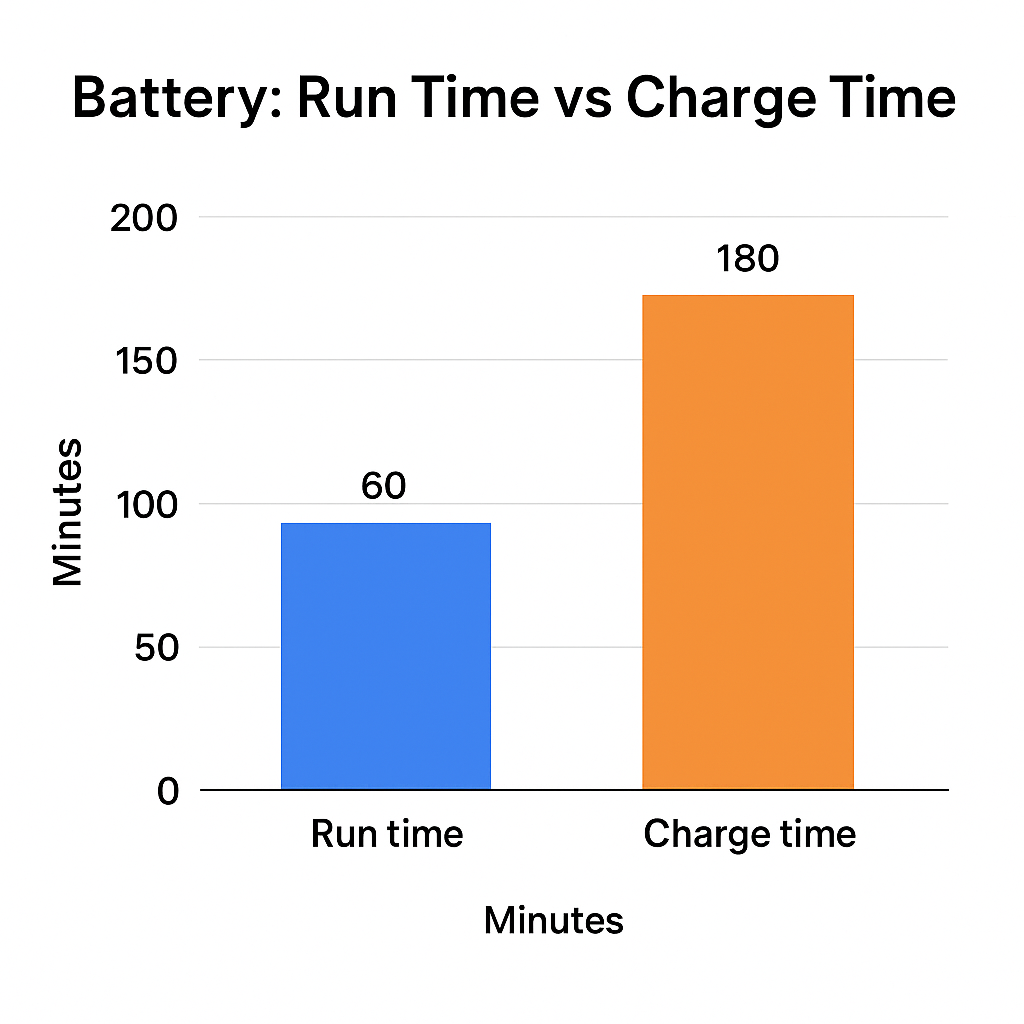
A simple visual: run time vs charge time
The product page lists 60 minutes of run time and 180 minutes of charging time.
Materials: what silicone + ABS tells you (without the marketing)
This product lists silicone and ABS as its materials.
- Silicone is widely used in consumer products because it can be flexible and durable; Wikipedia describes silicone as a polymer family with a silicon–oxygen backbone and notes common forms range from oils to rubber-like solids (see silicone).
- ABS (acrylonitrile butadiene styrene) is a common rigid plastic used in many durable goods; Wikipedia summarizes ABS as a tough thermoplastic with a balance of rigidity and impact resistance (see ABS).
Why this matters in real life:
- Silicone can contribute to a more comfortable surface feel.
- ABS often provides structure for internal components.
- Your cleaning approach should match the product’s manual and water-resistance design.
Pro Tip: When you buy any powered device, treat the included manual as part of the product. A great design with poor care habits won’t stay great for long.
Comfort-first sizing guidance (without graphic instructions)
If you’re deciding based on size alone, here’s a grounded way to think about it:
- Diameter is the comfort gatekeeper. A small change in diameter can feel like a big change in intensity.
- Length is about preference and anatomy. Longer isn’t better by default.
- Weight affects fatigue and leverage. Heavier can feel stable—but some people prefer lighter for ease of use.
With an insertable diameter of 1.38 in and weight of 0.66 lb, this product sits in a range many shoppers consider manageable—especially if you want something that doesn’t feel oversized.
Who it’s for (and who should skip it)
Use this table as a quick self-check. It’s not about “good” or “bad”—just fit.
| If you want… | This product may be a fit because… | Consider skipping if… |
|---|---|---|
| Beginner-friendly sizing | 1.38 in diameter; 6.1 in insertable length | You want significantly larger measurements |
| More control over alignment | 180° adjustable dual heads (per listing) | You prefer a completely fixed, non-adjustable design |
| Blended stimulation | Rabbit-ear style adds external contact | You only want internal sensation |
| Easier cleanup | IPX6 rating supports strong rinsing | You require verified full-submersion specs |
| Low-distraction sound | Listing claims <60 dB | You need independently tested lab noise ratings |
Hygiene & safer use: a minimal routine that makes a big difference
This section stays intentionally non-explicit. The goal is simple: reduce irritation and reduce the chance of transferring bacteria between bodies or uses.
Clean after each use (and between partners)
Public health guidance regularly reinforces basic hygiene around shared objects.
- The CDC includes “washing sex toys with soap and water after each use” as a practical hygiene step (see CDC’s Giardia prevention guidance).
- In CDC’s STI treatment guidance for women who have sex with women, they note that healthy practices may include “avoiding shared sex toys, cleaning shared sex toys, and using barriers” (CDC STI Treatment Guidelines: WSW).
Follow the manual for the “right” method
Planned Parenthood puts it plainly: “To know the best way to clean and care for your sex toys, read the directions that came with them …” (see Planned Parenthood’s page on Mycoplasma genitalium).
This matters for powered devices, seams, charging ports, and water-resistant designs.
⚠️ Warning: If you notice pain, numbness, skin irritation, or a persistent burning sensation, stop using the product and consider talking with a qualified healthcare professional. Comfort is a safety feature.
A quick, non-graphic cleaning checklist
If you’re searching for how to clean silicone sex toys, here’s the general logic most reputable guidance converges on—while still deferring to your specific manual:
- Clean promptly after use
- Use mild soap and warm water where appropriate
- Dry fully before storing
- Store in a clean, dry place (ideally away from dust and lint)
- If sharing between partners, use barriers and clean between uses
Video: safer cleaning basics (YouTube)
Note: The video above is included as a general educational reference. Always follow the care instructions in your product manual.
Buying checklist: what to confirm before you click “add to cart”
Before you buy any vibrating strap-on dildo, confirm these eight items:
- Clear sizing: insertable length + diameter listed
- Angle/alignment control: fixed or adjustable?
- Vibration control: enough range for your sensitivity?
- Water resistance: a real rating (like IPX6), not just “waterproof”
- Noise expectations: any dB claim or realistic description
- Materials stated: silicone + ABS (or other materials) clearly listed
- Manual included: care and charging guidance provided
- Discreet delivery: policy clearly spelled out
Discreet shipping: where to verify delivery expectations
If discretion and predictable delivery timelines matter, don’t rely on vague promises—check the policy page.
Kissself’s Shipping Policy states that shipping is discreet and provides order processing and delivery estimates.
FAQ
Is IPX6 “fully waterproof”?
IPX6 generally indicates protection against powerful water jets (see the IP code overview). That usually supports easier rinsing and splash exposure, but it doesn’t automatically mean the device is designed for extended submersion. Follow your manual.
How do I know if the size will be comfortable for me?
Start with diameter and your comfort history. If you’re unsure, choose a size with clearly listed measurements and consider a more gradual step-up approach. Comfort and control matter more than chasing “bigger.”
Is “<60 dB” actually quiet?
Decibels are logarithmic (see the decibel overview). Without standardized test conditions, the number is best used as a comparison point between products rather than an absolute guarantee.
What lube should I use?
Use the product manual as the deciding authority. If a manual recommends a specific type (often water-based for certain materials), follow that guidance.
Is it okay to share a toy between partners?
It can increase hygiene risk if you don’t clean between uses. The CDC discusses cleaning shared sex toys and using barriers as part of healthy practices.
Where to go next on Kissself
If you’re still comparing, these internal pages make it easier to browse:
- Browse the full catalog: Kissself Shop
- Explore similar category options: Dildos
Next step: see the full product details
If the specs and fit guidance above match what you’re looking for, the full listing is here: Vibrating Clitoral Strap Dildo Rabbit Ear 6.53 In (linked earlier in this guide).