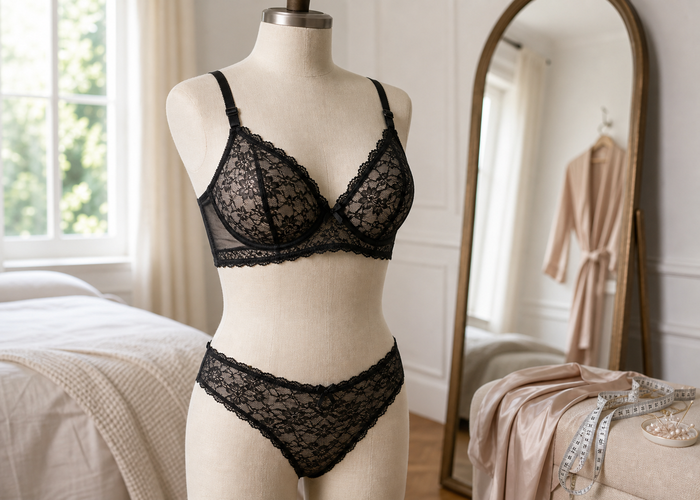
Learning how lingerie should fit is less about chasing a perfect size label and more about noticing what the garment does when you breathe, sit, reach, and move. Beautiful lingerie can look right on a hanger and still dig at the band, slide at the straps, flatten where it should support, or twist when you walk. Fit is the quiet difference between wearing lingerie and negotiating with it all evening.
This guide gives you a practical mirror-and-movement check. It applies to bras, bodysuits, babydolls, chemises, garter details, and delicate sets. It is not a strict rulebook for every body. Bodies change during the day and across the month, and lingerie fabrics stretch differently. The goal is comfort, support, and confidence, not a number that makes you feel pinned down.
If you are choosing a new piece from the KissSelf shop, start with the category and silhouette, then use the checks below before deciding whether a size, strap setting, or style needs to change.
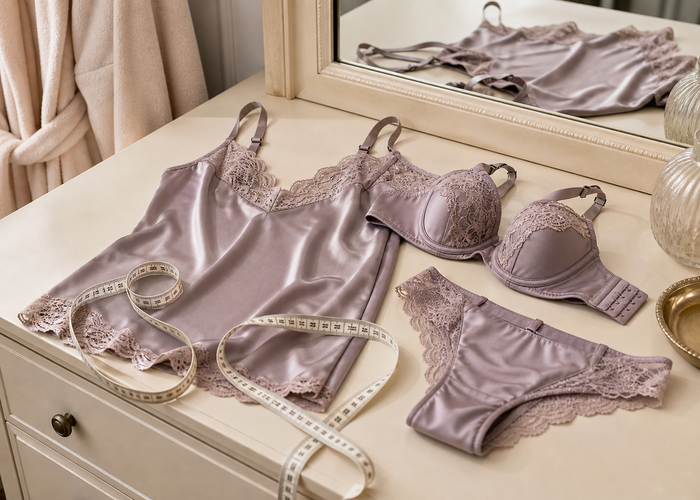
The band: the foundation of most lingerie fit
For bra-style lingerie, the band should sit level around the body. If it rides up in the back, the band may be too loose, the straps may be over-tightened, or the style may not match your shape. If the band digs painfully or leaves sharp marks quickly, it may be too tight or too narrow for the support you need.
A helpful test is the two-finger check. You should usually be able to slide two fingers under the band without the band floating away from your body. This is not a medical measurement; it is a comfort signal. Amoena’s lingerie measuring guide also emphasizes measuring the underbust and bust carefully rather than guessing from old sizes.
For bodysuits, the “band” may be a waist seam, underbust seam, or stretch panel. It should stabilize the garment without pulling the neckline down or creating tension at the snaps. If the torso length is wrong, sizing up or down may not solve it; you may need a different cut.
Straps should guide, not carry everything
Straps are adjusters, not the main support system. If you must tighten them until they dig into your shoulders, the band or cup may not be doing enough. If they slide even after adjustment, the strap placement may be too wide for your shoulders or the fabric may be too slick for the garment’s weight.
Adjust both straps while wearing the piece, then move your arms forward, overhead, and to the side. The garment should follow your movement without the straps twisting or the cup edge gaping dramatically. A little movement is normal; constant readjusting is a fit clue.
Cups, panels, and coverage
For structured cups, look for overflow, gaping, wrinkling, or pressure lines. Overflow can mean the cup is too small, too shallow, or too low-coverage for your shape. Gaping can mean the cup is too large, too tall, or simply not the right curve. Wrinkling in soft cups can also happen when fabric is delicate and unpadded, so judge comfort and support as well as appearance.
For unlined lingerie, coverage is often intentional and flexible. A sheer cup will behave differently from a molded cup. Ask a more useful question: does the fabric stay where you expect when you sit, turn, and breathe? If not, the issue may be style rather than size.
Seams should not fight the body
Seams are small, but they shape the experience. A side seam should lie relatively flat instead of twisting toward the front. An underbust seam should sit under the bust, not climb onto it. A center seam on a bodysuit should not pull the neckline down or create constant tension through the torso.
Check lace edges too. Lace can be soft, firm, scalloped, or textured. If an edge scratches in the fitting room, it may feel worse after an hour of movement. If a seam looks beautiful but creates a pressure point, the garment is asking too much of you. Comfort is not less glamorous; it is what lets the design work.
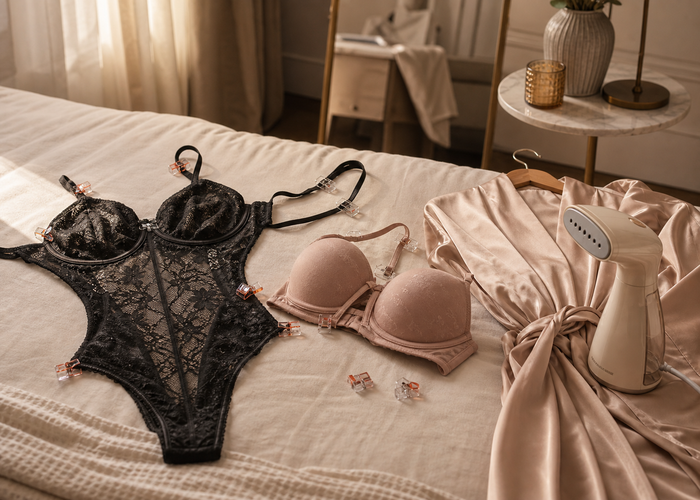
Movement test: sit, reach, twist, breathe
Do not judge lingerie only while standing still. Sit on the edge of the bed, reach for something, turn at the waist, and take a deep breath. The band should not roll, the straps should not fall, and the garment should not shift so much that you immediately want to fix it.
For babydolls and chemises, movement should feel easy through the hips and torso. For bodysuits, pay attention to torso length and snap placement. For garter details, check whether straps pull stockings too high or twist when you walk. For delicate lace, look for areas where tension may eventually tear the fabric.
Fit clues by garment type
| Garment | Good fit feels like | Warning sign |
|---|---|---|
| Bra set | Level band, straps stable, cups smooth enough for the style | Band rides up or straps dig hard |
| Bodysuit | Torso length allows sitting and breathing | Neckline pulls down or snaps feel strained |
| Babydoll | Underbust sits comfortably and skirt moves freely | Underbust seam climbs or cups gape |
| Chemise | Fabric skims without twisting | Side seams rotate or hem rides constantly |
| Garter set | Straps lie flat and adjust evenly | Clips twist or pull stockings unevenly |
Fabric stretch changes the answer
Mesh, lace, satin, elastic, and microfiber all behave differently. A satin chemise may need more ease because woven fabric has less stretch. A mesh bodysuit may feel comfortable at first and then relax slightly with wear. Lace can stretch in one direction and resist in another. The size label does not tell the whole story; fabric behavior matters.
Care also affects fit. Heat can damage elastic, and rough washing can distort lace. If you want delicate lingerie to keep its shape, hand wash or use a gentle bag and follow the garment label. A piece that once fit well but now rides up or feels slack may have tired elastic rather than a wrong body.
Confidence is part of fit
There is a practical reason to include confidence in a fit guide. If you feel like you must stand a certain way for the garment to “work,” you will probably not enjoy wearing it. Good lingerie gives you room to be a person: to sit, laugh, move, and forget the engineering for a while.
If a piece is almost right, try small adjustments before abandoning it. Loosen the straps, move to the next hook, change the stocking height, or add a robe layer. If several adjustments fail, let the style go. The best sexy lingerie is not the piece that wins on the hanger; it is the one that keeps working after you move.
How to measure without obsessing over numbers
Measurements are useful, but they should not become a verdict. Use a soft tape around the underbust, around the fullest part of the bust, and around the hips if the garment includes bottoms or a bodysuit. Keep the tape level and snug, not tight. Write the numbers down, then compare them with the specific product’s size chart rather than relying on a size you wore in another brand.
Between sizes, think about fabric and adjustability. A stretchy mesh babydoll may forgive more variation than a satin piece with limited stretch. A bra set with multiple hook positions and adjustable straps gives you more tuning room than a fixed lace bralette. A bodysuit needs torso length consideration in addition to bust and hip measurements.
If your measurements point to one size on top and another on bottom, that is not a problem with your body. It is a normal reason to prefer adjustable sets, tie-side details, stretch panels, or mix-and-match pieces. Good fit is built from options.
Try-on lighting and mirror checks
Use ordinary lighting at least once. Dressing-room or dramatic bedroom lighting can hide pressure marks and twisting seams. Stand in front of a mirror, then turn sideways and look at the back. The back view often reveals a riding band, rolling waist seam, or strap angle that the front view misses.
Check the garment after ten minutes, not only at the first moment. Elastic warms and settles. Lace edges may start to scratch after movement. A bodysuit may feel fine standing and strained after sitting. If a piece improves as it settles, great. If it worsens, that is useful information before a long evening.
Care habits that preserve fit
Even perfect lingerie fit can disappear if the garment is washed harshly. Heat weakens elastic, rough spin cycles can distort lace, and hanging heavy wet pieces by the straps can stretch them out. Use cool water, gentle detergent, and flat drying when the care label allows. Store molded cups without crushing them and close hooks so they do not snag lace.
If a once-loved piece no longer fits, inspect the garment before blaming your measurements. A stretched band, tired straps, bent underwire, or warped seam can change the fit dramatically. Lingerie has a lifespan. Replacing a worn piece is sometimes the most body-positive choice available.
How style changes the fit standard
A plunge bra, balconette, bralette, corset-inspired top, and sheer bodysuit are not trying to solve the same fit problem. A plunge style may show more center movement because the neckline is lower. A balconette may need a firmer band to keep the cup edge stable. A bralette may prioritize softness over lift. A bodysuit may depend on torso length more than bust volume.
This is why one “correct” fit rule can be misleading. Instead, ask whether the garment is doing what its design promises. If a soft bralette gives gentle coverage and does not roll or pinch, it may be fitting well even without dramatic lift. If a structured set promises support but the band rides up, it is not performing its job. Judge the garment by the job it was built to do.
Fit for long wear versus short wear
Some lingerie is meant for a long evening under clothes. Some is meant for a short, expressive moment. Long-wear pieces need stricter comfort standards: no scratchy seams, no rolling band, no straps that dig after ten minutes, and no closures that press when sitting. Short-wear pieces can be more dramatic, but they still should not hurt.
If you plan to wear lingerie under an outfit, test it with that outfit. A lace edge that feels fine alone may show through a fitted dress. A bodysuit that feels smooth standing may create lines when tucked into trousers. Movement and layering are part of fit.
Adjustments that are worth trying
Try the loosest comfortable hook on a new bra-style piece so the band has room to tighten as elastic relaxes over time. Adjust straps after the band is placed, not before. For garter straps, adjust while standing, then sit once to make sure the straps do not pull sharply. For bodysuits, check snap tension after sitting and standing again.
Small tailoring can sometimes help, especially with straps that are too long or a loose decorative element. However, tailoring cannot fix a fundamentally wrong cup shape, too-short torso, or painful band. Know the difference between a tweak and a mismatch.
Emotional fit matters too
Lingerie can carry a lot of expectation. Some people want softness, some want drama, some want support, and some want a private confidence ritual. Fit includes that emotional purpose. If a piece technically fits but makes you feel stiff, exposed in the wrong way, or preoccupied with flaws, it may not be the right piece for the moment.
The best fitting room question is simple: “Can I move like myself in this?” If the answer is yes, the garment is already doing something important. If the answer is no, you are allowed to choose a different cut, color, fabric, or level of coverage. Confidence grows faster when comfort gets a vote.
Online shopping fit strategy
When shopping online, read the size chart before reading reviews. Reviews can help, but they often reflect another person’s body proportions, preferred tightness, and styling goals. Use reviews to identify patterns, such as “torso runs short” or “band has firm stretch,” then compare those patterns with your own fit priorities.
Check whether the product has adjustable straps, hook-and-eye closures, stretch panels, tie sides, or fixed seams. Adjustable details give you more room to fine-tune. Fixed details can look sleek but require a closer size match. If you are between sizes and the piece has very little adjustability, consider the fabric stretch and the area where you most need comfort.
When to choose a different silhouette
If every bra-style set digs at the band, try a longline bralette or bodysuit that distributes pressure over a wider area. If bodysuits always feel too short, try a two-piece set, babydoll, or chemise. If delicate straps slide off your shoulders, look for racerback details, closer-set straps, or halter designs. Fit problems often improve faster when you change silhouette instead of fighting one shape repeatedly.
Coverage is also a silhouette choice. More coverage does not mean less sensual, and less coverage does not automatically mean more confident. The right level is the one that lets you relax. A person who feels grounded in a soft chemise may look and feel more confident than someone constantly adjusting a dramatic set that never quite settles.
A final five-point fit check
Before keeping a piece, ask five questions. Is the band or main support area stable? Do the straps stay comfortable after movement? Do seams lie where the design intends? Can you sit and breathe without tugging? Do you like how you feel after ten minutes, not just the first glance?
If the answer is mostly yes, the piece is probably worth keeping. If two or more answers are no, try a different size or style. The goal is not to pass a test; it is to find lingerie that works with your body in real time.
FAQ
Should lingerie feel tight?
It should feel secure, not painful. A supportive band may feel firm, but sharp digging, numbness, or immediate discomfort means something is wrong.
Why do my straps keep falling?
The straps may be too loose, too wide-set, or attached to a style that does not match your shoulder shape. Over-tightening is not always the answer.
What if my top and bottom sizes are different?
That is common. Look for mix-and-match sets, adjustable pieces, or silhouettes that do not require one size to solve both areas.
How do I know if a bodysuit torso is too short?
If the neckline pulls down, the shoulder straps dig, or the snaps feel strained when you sit, torso length may be the issue.
Knowing how lingerie should fit gives you permission to judge the garment instead of judging your body. Check the band, straps, seams, and movement, then choose the piece that lets you feel comfortable enough to stop adjusting and start enjoying it.