
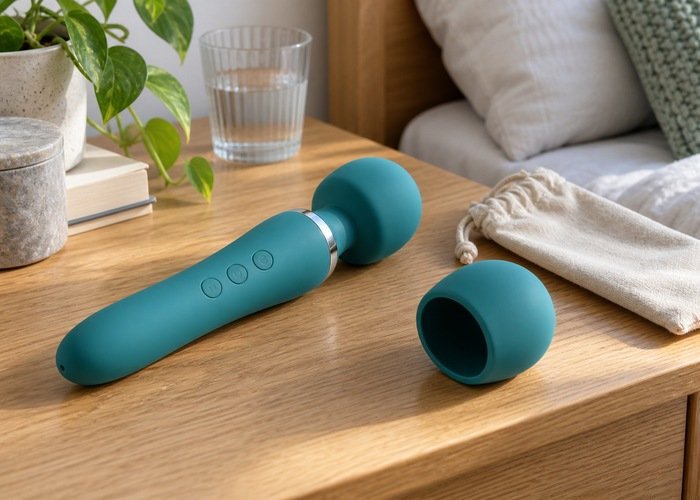
Choose a detachable vibrator when you can name the removable feature you will actually use, understand how every part is cleaned, and obtain replacements for the exact model. Choose a fixed design when fewer pieces and a shorter setup matter more than changing accessories. Neither construction is automatically safer, more durable, or better value. The useful comparison is what you must do to keep the complete product working, not how many items appear in the box.
The detachable versus fixed vibrator decision becomes clearer when you separate three things: an accessory that changes the contact surface, a module that contains its own electronics, and a component intended only for servicing. They can look similar in a photograph while creating very different responsibilities. A removable silicone cover does not mean the motor housing opens, and a separately controlled function does not necessarily mean a separately washable part.
Start with the model descriptions in the vibrator collection, then request the manual for each serious candidate. Compare the everyday sequence: unpack, assemble, operate the controls, switch off, separate only the permitted parts, clean, dry, and store. A design that fits that sequence comfortably is more useful than a large accessory set that repeatedly leaves you unsure what belongs where.
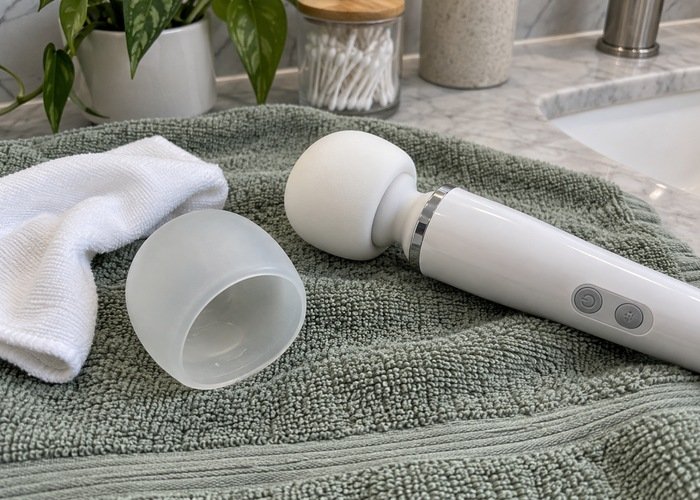
First identify what is actually detachable
Read the parts diagram rather than relying on terms such as modular, multifunction, or two in one. Those terms may describe different operating functions inside one sealed body. They may instead refer to a small independent device that fits into a larger holder, or to interchangeable passive accessories fitted over a powered head. The manual should distinguish these arrangements and explain the permitted assembly.
For a passive cover, ask which surface contacts the product underneath, whether the inside can be cleaned, and how it is dried before refitting. For a powered module, ask whether it has a separate battery, charging connection, switch, and water-exposure limit. For a service component, ask who is allowed to remove it. Never treat an accessible screw, seam, or charging cover as an invitation to dismantle the housing.
A fixed product can still have different materials, recessed buttons, and a charging interface. Fixed therefore does not mean seamless, and detachable does not mean fully washable. Keep the comparison tied to visible construction and written instructions. If the seller cannot identify the removable parts consistently across photographs and descriptions, that is an unresolved buying question rather than a detail to work out after delivery.
Compare the ownership tasks, not the accessory count
| Ownership question | Detachable construction | Fixed construction |
|---|---|---|
| What must be tracked? | The main unit plus each necessary cover, module, connector, and compatible cable. | The complete unit and its required charging accessories. |
| What needs cleaning access? | Approved removable surfaces, inner cavities, and the permitted mating areas. | Exterior surfaces, seams, recesses, and other areas identified in the manual. |
| What can be replaced? | Only components the manufacturer actually supplies and approves for that model. | Whatever replacement or service options the manufacturer explicitly offers. |
| What can make setup inconvenient? | Misplaced pieces, ambiguous orientation, or a connection that is difficult to check. | A shape or control layout that cannot be changed to suit the owner. |
| What must be confirmed before buying? | Exact compatibility, availability, assembly instructions, and separate care limits. | Overall fit, reachable controls, complete care instructions, and service arrangements. |
Use the table to eliminate unsuitable arrangements rather than assigning an arbitrary score to every feature. If you lack a private place to dry several components, easy separation may not be an advantage. If one approved removable cover solves a specific handling problem, that small accessory may be more valuable than a package containing numerous shapes you do not expect to use.
Think about the consequences of losing each part. A missing optional cover might simply remove one choice, while a missing required connector might make the entire product unusable. Ask whether the main unit is intended to operate without that component. Do not assume that a removable accessory is optional merely because you can physically take it off.
Ask for evidence that matches the whole product
The Swedish Institute for Standards explains that ISO 3533 addresses material, design, and user-information safety requirements for products intended for direct genital or anal contact. Its existence does not establish that a particular item has been assessed against it. When a seller refers to a standard, ask which model and configuration the supporting documentation covers. A general statement about a supplier is not a model-specific answer.
Apply that distinction to accessories as well. A claim concerning one surface material does not identify every coating, adhesive, rigid insert, or additional component in a kit. Ask for the materials of the pieces you will handle and the permitted cleaners for each. The body-safe vibrator checklist provides a separate starting point for evaluating material information; modular construction should not replace that basic assessment.
Clear documentation should also explain foreseeable owner mistakes, such as fitting the wrong attachment or leaving a required piece partly engaged. You do not need to invent a home laboratory test. You need instructions that let you recognize the correct assembly without unusual force, improvised tools, or guesswork. An unexplained gap or persistent looseness deserves a manufacturer response before use.
Build a separate cleaning plan for each component
For a detachable product, write a short parts list and place a cleaning instruction beside every item. Include the inside of any permitted removable cover, not just the surface visible in the product photograph. If a cavity cannot be reached or allowed to dry under the stated instructions, ask the manufacturer how it should be maintained. Do not compensate by choosing a stronger cleaner or an unapproved brush.
Separation can expose surfaces that were previously hidden, but it also adds handling steps. A sensible workspace lets cleaned pieces remain separate from uncleaned pieces and prevents small components disappearing into a sink or drawer. Keep the unit switched off and disconnected from charging equipment while following its care instructions. The product manual, rather than the appearance of a material, determines whether rinsing or immersion is permitted.
IEC 60529 concerns protection provided by enclosures through the IP classification system. For this buying decision, the practical question is which enclosure and assembled condition a stated rating describes. It does not follow that a removable electronic module, a remote, and the main body share the same water-exposure permission. Request the limits separately when the documentation is unclear.
A fixed design avoids reassembly of contact accessories, but it still deserves an inspection of seams and recesses. Look for areas where you cannot easily see whether cleaning is complete. Compare access under the permitted method, not under an imagined method involving disassembly. Our guide to waterproof labels and IP limits explains why a water-resistance claim and a complete care procedure are different pieces of information.
Check the connection without improvising a repair
Ask how correct engagement is indicated: a documented alignment mark, a particular orientation, a specified closure position, or another clear cue. Do not require an audible click unless the instructions say the connection should click. A friction-fit cover and a mechanical latch work differently. Your aim is to recognize the intended final position, not force every design to behave like another product you already own.
Before each assembly, inspect the accessible surfaces for visible damage or trapped debris. Follow the manual for any required drying and positioning. If a formerly secure component now shifts, develops a crack, or no longer seats normally, stop using that assembly and contact support. Adding adhesive, tape, an improvised spacer, or a substitute fastener may change the fit without resolving the underlying problem.
UL Solutions’ enclosure and component certification information illustrates that enclosure evaluation is a distinct technical subject. It is not a certification of the products discussed here. For an owner, the important boundary is simple: a user-removable accessory is not permission to alter the electrical housing. Keep servicing questions separate from the ordinary assembly steps provided in the manual.
Compatibility needs a model number, not a resemblance
Two accessories can appear identical while differing in dimensions, attachment geometry, material, or intended host model. Ask for the exact replacement reference and the models it supports. If a product has multiple generations, include the generation or revision in your question. A description such as fits most wands is not enough to establish compatibility with a particular unit.
Save the original listing, manual, model label, and support reply in one place. For an accessory that the manufacturer says is replaceable, check whether the replacement is currently offered, whether it is an individual item or part of a bundle, and whether it can be delivered to your location. Avoid buying speculative spare parts for a model whose compatibility has not been confirmed.
Be especially careful when the detachable component carries electrical power. Physical fit alone cannot establish charging compatibility. Keep the supplied or explicitly approved charging arrangement with its intended device; a connector shape is not a complete electrical specification. UL Solutions describes separate battery safety testing and certification services, reinforcing why a battery-related claim should be tied to actual supporting documentation rather than the appearance of a cable.
Count charging and control systems before choosing
A product with two functions may use one battery and one set of buttons, while a modular arrangement may involve more than one powered unit. Ask how many items require charging, whether each has a charge indicator, and how you identify the correct cable. More components do not automatically create a problem, but their maintenance should fit the routine you are willing to follow.
Keep charging accessories separate from items that still need cleaning or drying. Do not close a damp component inside a fitted storage recess merely because the case has room for it. If the product includes a charging case, determine exactly which items the case charges and which it only stores. The charging-case vibrator guide can help you ask those questions without treating every case as interchangeable.
Control arrangements deserve their own check. Confirm that you can switch off each powered component locally, understand any locking function, and recognize whether a removed module remains active. Read the instructions before assuming a remote controls everything in the kit. Our remote versus app control comparison covers that separate decision. The ownership advantage comes from understanding the system, not from having the highest number of independent functions.
Work out cost from the parts you genuinely need
Compare the complete purchase you would make today: the selected model, any required accessory not included, delivery, and any confirmed replacement you already know is necessary. Keep optional extras in a separate column. This prevents a large bundle from looking economical simply because you assign value to every included piece, regardless of whether it serves a purpose for you.
Then list uncertainties without assigning invented prices. Is an accessory replaceable but currently unavailable? Would servicing require sending the whole unit away? Does support distinguish a damaged cover from an electrical fault? These are ownership risks to investigate, not numbers to disguise with an assumed lifespan. Neither a fixed shell nor a detachable head guarantees a particular number of years of service.
Read the applicable warranty and return terms before opening packaging. Ask how faults, missing parts, and replacement accessories are handled; do not presume that ordinary change-of-mind returns apply to an opened intimate product. Keep the seller’s answer and proof of purchase. Product support that can identify a part accurately may matter more than an accessory count printed prominently on the box.
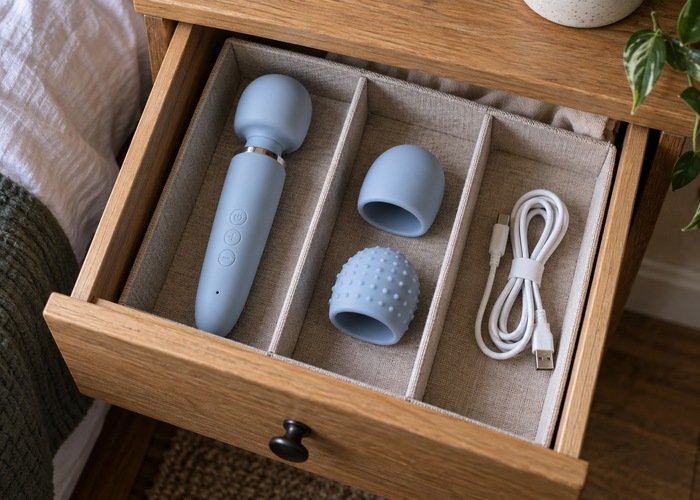
Choose a storage arrangement that keeps parts identifiable
A modular set needs a home where each necessary component remains visible or easy to locate. Use storage suitable for the product materials and follow the manufacturer’s drying instructions before closing a pouch or compartment. Keep model information with the storage location rather than relying on memory. If you own similar-looking sets, separate their approved accessories so a hurried reassembly does not become a compatibility experiment.
For a fixed unit, confirm that the storage arrangement protects its controls and prevents unnecessary strain on any attached lead. For either construction, avoid packing a product while it is still awaiting cleaning or assessment for damage. A compartment that fits the object is not necessarily an appropriate charging location; follow the charging instructions rather than treating storage and charging as the same task.
Plan for eventual disposal as well. The US EPA’s lithium-ion battery guidance advises against putting these batteries, or devices containing them, into household trash or ordinary recycling bins. Use appropriate collection arrangements and local instructions. A detachable contact accessory does not mean the battery is user-removable; do not open a sealed device merely to separate its battery without manufacturer guidance.
Questions worth sending before placing an order
Consider a simple hypothetical comparison. One package contains a fixed unit and its cable. Another contains a powered handle, three passive covers, and a cable. If only one cover suits your intended use, compare that assembled configuration with the fixed unit first. Then ask what the other two covers add to your actual routine. Their presence should not excuse unclear cleaning instructions or an uncomfortable handle.
Now imagine losing the preferred cover. If the manufacturer offers an identified replacement and the remaining approved configuration still meets your needs, the modular design has a practical advantage. If no replacement is available and the bare handle is not intended for use, the apparent flexibility has a limit. This exercise reveals dependency without pretending to predict a failure rate.
- Which exact parts can the owner remove, and which must remain assembled?
- Does every component have a documented cleaning and drying method?
- What indicates that an attachment is correctly fitted?
- Can the main unit operate without the accessory, according to the manual?
- What are the replacement references and supported model generations?
- How many batteries, charging connections, and local power controls are involved?
- What should I do if a connection becomes loose or a component is damaged?
Keep answers specific. A reply that repeats easy to clean or universal attachment has not answered a question about an inner cavity or a model revision. Ask once more with the relevant photograph or reference number. If essential care or compatibility information remains unavailable, choose a better-documented alternative rather than accepting uncertainty as the price of extra features.
Frequently asked questions
Is a detachable design easier to clean?
Only when the permitted separation makes relevant surfaces accessible and the instructions cover cleaning and drying every piece. Additional cavities, connections, and loose parts can add work. Compare the actual care sequence for the models you are considering instead of assuming that removable always means simpler.
Does a fixed design last longer?
Construction alone cannot establish service life. Materials, manufacturing quality, handling, care, battery condition, and support all matter. A fixed product avoids certain accessory connections but may offer fewer replaceable external parts. Ask about the actual service arrangement rather than accepting a general durability claim.
Can I use an attachment that appears to fit?
Use only a combination the manufacturer approves for the exact model. A similar shape does not confirm compatibility, and forcing a component into place is not a valid test. Obtain a clear model-specific answer before buying or assembling a substitute.
Which construction is the better first purchase?
Choose the one whose complete routine you understand and can maintain. A straightforward fixed product may suit someone who wants fewer pieces; a documented detachable system may suit someone with a specific accessory need. The best detachable versus fixed vibrator comparison ends with a clear ownership plan, not the longest feature list.