You open a product page and find three familiar words: suction, tapping and vibration. The difficulty starts when they are treated as interchangeable. Does tapping mean the entire device moves? Does “3-in-1” mean three motors? And if the page lists several patterns, does each function have its own controls?
This guide uses the published information for one curved, three-function model to separate those ideas. It is an explanation of specifications and ownership questions, rather than a hands-on review. We have not independently tested this device or verified its performance claims.
Three actions, three different questions
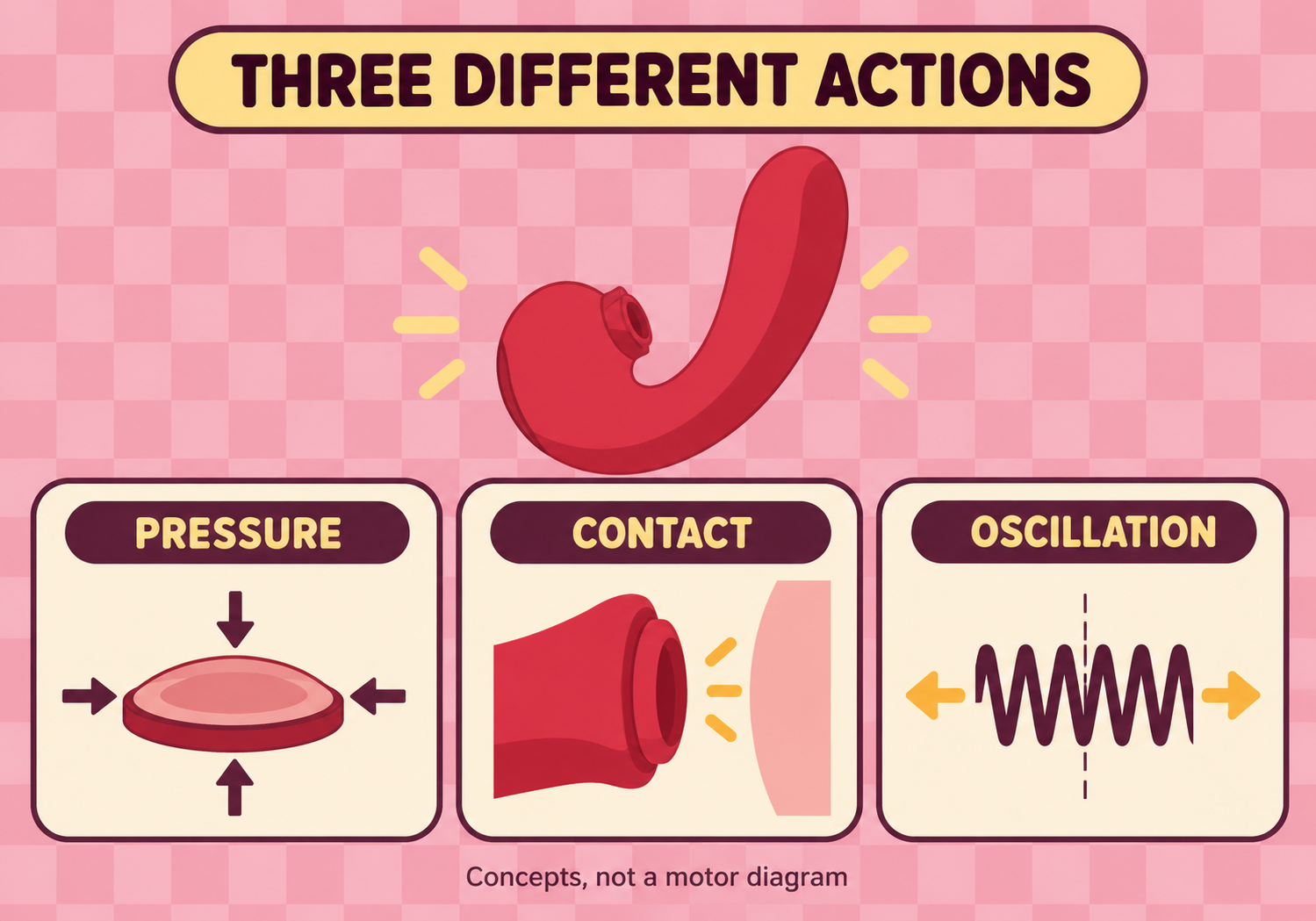
Suction: what happens to pressure?
In product descriptions, suction refers to a pressure-related action associated with an opening. This model’s page describes a focused suction opening, but does not provide a pressure measurement or a technical account of how that pressure is produced. The word alone cannot tell you the strength, waveform or internal pump design.
That distinction matters when comparing descriptions. “Pulsing” can describe a changing pattern; it does not prove that two devices use the same mechanism. A photograph of an opening also cannot supply the missing measurements.
Tapping: what makes repeated contact?
Tapping describes repeated contact or a localized movement associated with that contact. It should not automatically be read as whole-shaft thrusting. The present listing names tapping, but does not document the moving component, its travel distance or its timing. An internal cutaway would need manufacturer evidence; drawing one from the product name would create false precision.
Vibration: what oscillates, and in what pattern?
Vibration means repeated oscillating movement. In basic physics, oscillation involves movement around an equilibrium position, as explained in OpenStax’s introduction to oscillatory motion. This explains the term, not this model’s engineering.
Frequency, movement amplitude and the timing pattern are separate properties. A setting that changes the rhythm is not necessarily a higher intensity. The listing mentions multiple vibration patterns without giving an exact count or measured output, so there is no supported numerical comparison to make here.
What this particular model actually lists
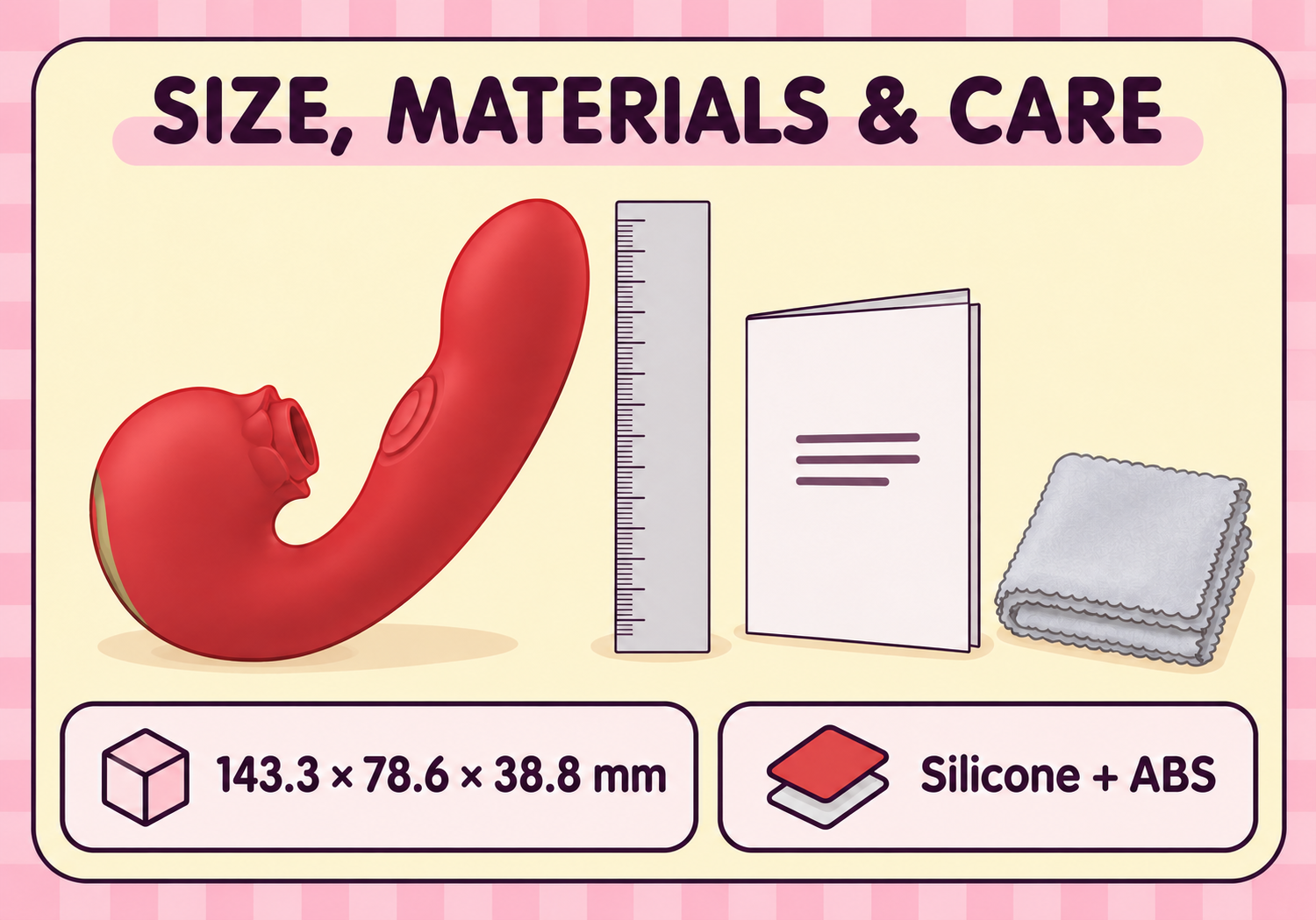
The published specification describes silicone and ABS construction, USB charging, an IPX7 claim, and red or purple color options. It gives the dimensions as 143.3 × 78.6 × 38.8 mm. Those details are more useful when each is kept within its limits:
- Three functions: suction, tapping and vibration are named; independent operation and motor count are not established.
- Dimensions: a three-number size specification is provided, without a labeled drawing identifying each axis or usable section.
- Materials: silicone + ABS is listed, without a component-by-component material map.
- Power: USB rechargeable is stated; charging time, runtime and charger requirements are not confirmed in the text reviewed.
- Water protection: IPX7 appears in the listing; a model-specific test report and detailed immersion instructions were not available for this guide.
The important size mistake is treating 143.3 mm as an insertable length. A total dimension may include the base, curve or other structures. Likewise, a width somewhere on the housing does not establish the width of every section. A labeled technical drawing would answer those questions; an attractive silhouette cannot.
For the related distinction between a function and a selectable setting, our guide to device functions and modes explains why a bigger number in a product name is not a reliable measure of control complexity.
The missing information is a control map
Imagine trying to switch off one action while leaving another running. Knowing that three actions exist does not tell you whether this is possible. The necessary information is a control map: which button starts and stops the device, what a short or long press does, and whether each action can be selected separately.
A useful instruction sheet would also identify any travel lock, memory setting or automatic shutoff if the model has them. None should be assumed. “USB rechargeable” describes a charging connection; it does not establish Bluetooth, app support or remote control.
If your instructions are incomplete, use customer help to request the exact button sequence for your model. A concise question is: “Can you provide the control diagram and confirm whether suction, tapping and vibration can be stopped independently?” This asks for an answer that a feature list cannot provide.
Materials and water resistance need separate care decisions
“Silicone + ABS” describes a combination
It does not mean every surface is silicone, or identify where the ABS is located. It also does not establish medical-grade certification. For cleaning, the practical question is which surfaces, seams and openings can be cleaned by which method. Do not assume a component detaches unless the instructions show it; our explanation of detachable and fixed components covers why that distinction changes maintenance.
IPX7 does not answer every cleaning question
The IEC 60529 standard classifies enclosure protection through the IP Code. A listed IPX7 rating is therefore a water-protection statement, not permission to boil an assembled electronic device, use any chemical cleaner or wash a charger.
For this model, keep the distinction between a seller’s rating and independently verified test evidence visible. Follow its supplied care instructions rather than improvising an immersion procedure from the rating alone. Our guide to IP ratings and their limits explains this boundary in more detail.
A practical routine is to inspect the device for damage, follow the specified cleaning method, allow it to dry fully and store it separately. Keep charging equipment dry and follow the model’s electrical instructions. The care checklist can help organize those steps, but cannot replace missing manufacturer directions.
Sharing adds a separate hygiene issue. Chelsea and Westminster Hospital NHS guidance advises avoiding sharing sex toys; if shared, wash them or use a new condom for each new person. That advice does not mean that an unspecified rinse sterilizes an electronic device.
Frequently asked questions
Does 3-in-1 mean this device has three motors?
No motor count is confirmed in the information reviewed. The name identifies three advertised functions. Establishing the number of motors would require model-specific technical documentation.
Is tapping another word for thrusting?
They should not be treated as equivalent. Tapping describes repeated contact; thrusting describes a different movement claim. This listing does not establish whole-shaft thrusting or a measured travel distance.
Can all three functions run independently?
The text reviewed does not confirm independent selection, simultaneous operation or separate intensity control. Request the model’s button diagram before assuming a particular combination is available.
Is 143.3 mm the insertable length?
The listing provides that number within a three-dimensional size specification, without a labeled usable-length measurement. It should not be presented as an insertable length.
Does IPX7 mean the whole device can be boiled?
No. Water-ingress protection does not establish heat resistance or a sterilization method. Follow model-specific cleaning instructions, including any restrictions around seams, openings and charging parts.
Product information checked October 23, 2026. This article explains the published listing; it does not certify the device, document laboratory testing or replace its instructions.