

There’s a quiet frustration that many people never talk about: you’ve upgraded your toy, cranked the intensity to maximum, and yet the climax feels further away than ever. That dull, almost numb sensation isn’t in your head — it’s a well-documented physiological response, and it’s exactly why sensory innovation is reshaping the pleasure tech space.
The phenomenon often called “vibrator toe” — that creeping desensitization after prolonged high-frequency stimulation — happens because your nerve endings adapt. Constant buzzing at a fixed frequency essentially trains your mechanoreceptors to tune it out, like background noise you stop hearing after a while. More intensity doesn’t solve this problem. It accelerates it.
“Vibration alone can sometimes lead to desensitization or a ‘numbing’ effect for some users. Mechanical actions like tapping, lapping, or flicking provide a varied sensory input that more closely resembles human touch.” — Dr. Emily Morse, Sexologist
This is the “more power is better” myth — and it’s actively working against your orgasm. The nervous system craves variation, not escalation. Human touch is never a single, unbroken frequency. It pulses, shifts, and surprises. That’s precisely what makes it so effective.
Enter a new design philosophy built around mechanical mimicry — recreating the rhythmic, dynamic pressure of real physical contact. Technologies like the “Biting Mouth” and tapping mechanisms, most notably found in innovations like a rabbit vibrator with tapping functionality, are engineered to replicate exactly that varied sensory input your body actually responds to.
Understanding why these approaches work, though, requires a closer look at the remarkable complexity of clitoral anatomy — and the very specific neural pathways that different types of stimulation activate.
The Science of the 10,000: Understanding Clitoral Complexity
Standard vibration fails so many people for a reason rooted in biology. To understand why tapping and oral-mimicry outperform constant buzzing, you first need to rethink what the clitoris actually is.
The clitoris is not a button — it’s an architecture. According to The Journal of Sexual Medicine, the clitoris contains over 10,000 nerve endings, with the highest concentration clustered in the glans and the surrounding hood. Beneath the surface, the internal structure extends several inches in either direction, wrapping around the vaginal canal in two curved “legs.” Most conventional toys address only the visible tip, leaving the majority of that nerve-rich network completely untouched.
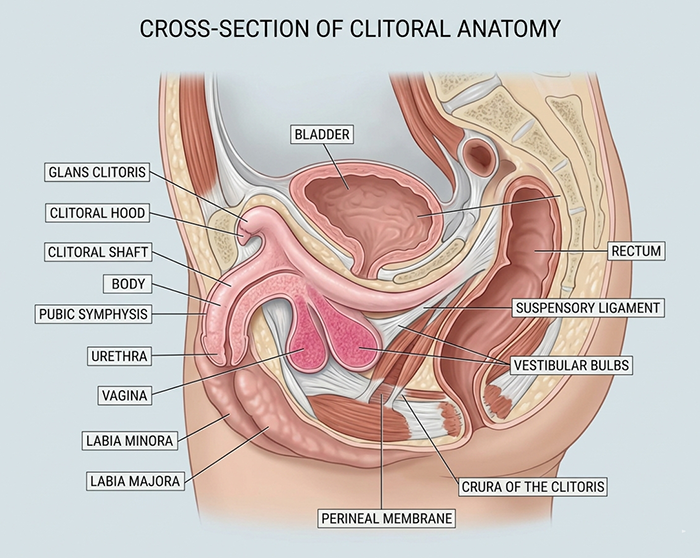
Did You Know? The clitoris has roughly twice the nerve endings of the entire penis — all concentrated in a structure about the size of a wishbone. Stimulating only the external glans is essentially playing one note on a full piano.
Multi-directional pressure changes everything here. When stimulation targets both the glans and the hood simultaneously — pressing downward and sideways rather than simply buzzing against one spot — it activates a wider spread of nerve endings across multiple planes. That layered engagement is what starts building toward the blended orgasm experience referenced throughout this article.
Then there’s the question of how pressure is delivered. The body’s mechanoreceptors — sensory receptors that respond to physical touch — react very differently to rhythmic, intermittent contact than to constant, unvarying stimulation. Prolonged buzzing can actually cause mechanoreceptors to temporarily desensitize, which explains the plateau effect described earlier. Rhythmic tapping, by contrast, delivers repeating “on-off” pulses that keep those receptors firing fresh with every cycle.
Oral-mimicry takes this a step further by triggering an entirely separate neural pathway — one the brain already associates with intimacy and arousal. This is precisely why a clit tapping mouth stimulator design isn’t just a novelty; it’s replicating a biological shortcut your nervous system already knows.
That’s the mechanical logic worth examining next.
Mechanical Mimicry: The ‘Biting Mouth’ Revolution
Understanding why vibration falls short is only half the equation. The more exciting question is what comes next — and the answer, increasingly, is a design philosophy rooted in mechanical mimicry: engineering that doesn’t just stimulate, but replicates.
Enter the “biting mouth” stimulator, a category of device that translates the nuanced sensations of oral sex into precise, repeatable mechanics. And it’s changing the conversation around climax in a meaningful way.
The Bite: Rhythmic Compression, Not Pain
The word “biting” can raise an eyebrow, but the sensation is nothing like it sounds. What’s actually happening is gentle, rhythmic compression — soft, pulsing pressure applied at controlled intervals. Think less “chomp” and more “soft lip pressure,” the kind that varies in intensity and rhythm. This cyclical squeeze-and-release engages nerve endings differently than continuous vibration, preventing sensory habituation and keeping arousal escalating rather than plateauing.
The Tongue: Replicating the ‘Lapping’ Sensation
Alongside the compression mechanism, many mouth-designed stimulators incorporate a tongue-like flicking element that mimics the lapping motion of oral stimulation. This isn’t a cosmetic feature — it directly replicates the variable, directional pressure that makes oral sex so effective for many people. Research published in the Journal of Sex & Marital Therapy found that only about 18.4% of women report vaginal intercourse alone as sufficient for orgasm, underscoring just how critical this kind of targeted external stimulation actually is. A tongue-motion feature delivers exactly that kind of focused, dynamic contact.
The Suction: Hands-Free Targeting and Precision Hold
The third element — and arguably the most practical — is the mouth-shaped housing itself. Designed to create a seal around the clitoris, it enables a degree of targeted suction that keeps the device positioned without constant manual adjustment. This hands-free stability matters enormously for those who struggle with positioning during partnered sex or solo use. For anyone who has found it difficult to reach climax through intercourse alone, a tapping clitoral stimulator built with this mouth architecture offers something genuinely different: consistent, pinpointed contact that doesn’t drift.
The Kissself official store offers a direct look at how this design philosophy translates into a real product built around these three mechanics working in concert.
What pairs naturally with this biting-mouth approach? A rhythmic tapping mechanism — and that’s exactly where the next frontier gets even more interesting.
The Tapping Rabbit: Why Rhythmic Pressure Beats Constant Buzzing
So we’ve established that the clitoris is far more complex than it appears, and that oral-mimicry technology is rewriting what stimulation can feel like. But there’s another mechanical innovation worth understanding in depth — one that directly addresses the frustrating numbness that derails so many people mid-session.
Enter the tapping rabbit sex toy: a design category built around rhythmic, pulsed contact rather than continuous vibration.
The Physics Behind the Tap
Traditional vibrating rabbits deliver high-frequency oscillation — essentially a constant hum of motion against the skin. Tapping works differently. Instead of sustained contact, it uses kinetic energy delivered in discrete beats, similar to how a finger rhythmically drumming on a surface feels completely different from pressing and holding. Each tap creates a small pressure wave that travels through the clitoral hood and into the deeper internal structures, engaging nerve clusters that surface-level buzz rarely reaches.
According to the Sexual Wellness Research Archive, mechanical tapping provides varied sensory input that prevents sensory adaptation, leading to more intense arousal peaks. That matters enormously, because adaptation — your nervous system essentially tuning out a repetitive signal — is the root cause of the numbing effect.
Tapping vs. Vibrating: A Direct Comparison
| Feature | Tapping | Vibrating |
|---|---|---|
| Sensory input type | Varied, rhythmic intervals | Constant, uniform frequency |
| Risk of numbing | Significantly lower | High with prolonged use |
| Depth of stimulation | Reaches deeper nerve endings | Primarily surface-level |
| Arousal escalation | Builds progressively | Can plateau quickly |
| Recovery time needed | Minimal | Often required |
The ‘Drumming’ Effect on the Clitoral Hood
One of the most compelling aspects of tapping technology is how it interacts with the clitoral hood — the protective fold of skin that naturally covers the glans. A rhythmic drumming motion against this tissue creates escalating pressure that gradually draws blood flow to the area, functioning almost like a warm-up sequence. Arousal builds in waves rather than hitting a ceiling.
However, it’s worth noting that individual sensitivity varies considerably. What feels perfectly calibrated for one person may feel too intense or too subtle for another — which is why adjustable rhythm settings are a critical feature to look for.
This progressive, adaptive quality of tapping naturally sets the stage for something even more powerful when internal stimulation enters the picture.
The Holy Grail: Mastering the Blended Orgasm
The blended orgasm sits at the intersection of two powerful pleasure pathways: G-spot stimulation deep inside and precise clitoral activation on the outside. When both zones are engaged simultaneously, the result is widely described as more intense, more full-bodied, and more emotionally resonant than either experience alone. It’s not just a louder version of a single orgasm — it’s a fundamentally different one.
The combination of ‘fullness’ internally and ‘precision’ externally isn’t just physical — it creates a psychological sense of complete engagement that amplifies every sensation.
According to the International Society for Sexual Medicine, approximately 70% of users who utilize toys that target both internal and external zones simultaneously report higher levels of blended orgasms — a figure that underscores just how significant dual stimulation really is.
How the Kissself Tapping Rabbit Synchronizes Both Zones
The Kissself Tapping Rabbit is engineered specifically for this dual-target approach. The internal shaft delivers rhythmic tapping pressure directly against the G-spot, while the external head provides the kind of clitoral tapping and licking sensation that mimics oral mechanics. These two actions work in mechanical synchronization — not independently, not randomly — which is what makes the blended experience feel cohesive rather than chaotic.
3 Steps to Achieve a Blended Orgasm
- Layer stimulation gradually. Start with internal tapping alone to build G-spot arousal before activating the external head. Rushing both zones simultaneously from the start can feel overwhelming.
- Match rhythms intentionally. Experiment with settings where internal and external pulses align — synchronized patterns tend to build toward climax more predictably than offset rhythms.
- Add a partner’s touch. Partners can hold or guide the device, adjusting angle and pressure in real time. This shared control introduces a psychological layer of connection that solo use simply can’t replicate, deepening intimacy alongside the physical sensation.
On the other hand, not every body reaches blended orgasm the same way — patience and exploration matter more than any single technique. The right settings look different for everyone. Explore the Kissself Tapping Rabbit to find the configuration that works for you.
Ready to see exactly how these movements come together? The next section puts it all in motion — visually.
Visual Guide: Seeing the Tapping Action in Motion
Watch the biting mouth tongue clitoral stimulator mechanism flex and rhythmically tap in real-time. Notice how the soft rabbit ears adjust to different anatomical angles across multiple intensity modes — what reads as mechanical on paper becomes immediately intuitive once you see it move.
Understanding these movements visually matters. The flexible ear construction is especially telling — you can observe how it contours rather than clamps, which is precisely the anatomical adaptability that makes blended stimulation possible for a wider range of body types. Seeing the modes shift from gentle pulse to rapid tap clarifies what words struggle to convey.
If you still have questions about how these devices actually feel in use, the next section addresses the most common ones head-on.
Frequently Asked Questions About Tapping & Biting Stimulators
Does the “biting” sensation actually hurt? Not at all. The “biting” action uses ultra-soft silicone flanges that apply gentle, rhythmic pressure — nothing sharp or pinching. Pressure intensity is fully adjustable, so you control exactly how firm or feather-light the sensation feels. Think of it as a tender, pulsing squeeze rather than anything aggressive.
How do I clean a device with a mouth-style opening? Most models are fully waterproof and body-safe, meaning warm water and a few drops of toy cleaner do the job. Use a soft brush or cotton swab to reach inside the opening, rinse thoroughly, and air dry completely before storing.
Is the tapping mechanism loud? Tapping technology is surprisingly quiet. The mechanical tapping action produces far less vibration noise than traditional motors, making these devices noticeably discreet during use.
Can it be used solo and with a partner? Absolutely — versatility is one of the biggest selling points. Solo sessions benefit from hands-free positioning options, while partner play opens up creative angles for simultaneous stimulation. The compact design makes shared exploration genuinely effortless.
The bottom line: tapping and biting stimulators remove the guesswork from blended pleasure, putting precise, customizable control directly in your hands.
Key Takeaways
- Layer stimulation gradually. Start with internal tapping alone to build G-spot arousal before activating the external head. Rushing both zones simultaneously from the start can feel overwhelming.
- Match rhythms intentionally. Experiment with settings where internal and external pulses align — synchronized patterns tend to build toward climax more predictably than offset rhythms.
- The clitoris is not a button — it’s an architecture.
- kinetic energy delivered in discrete beats
- approximately 70% of users who utilize toys that target both internal and external zones simultaneously report higher levels of blended orgasms