
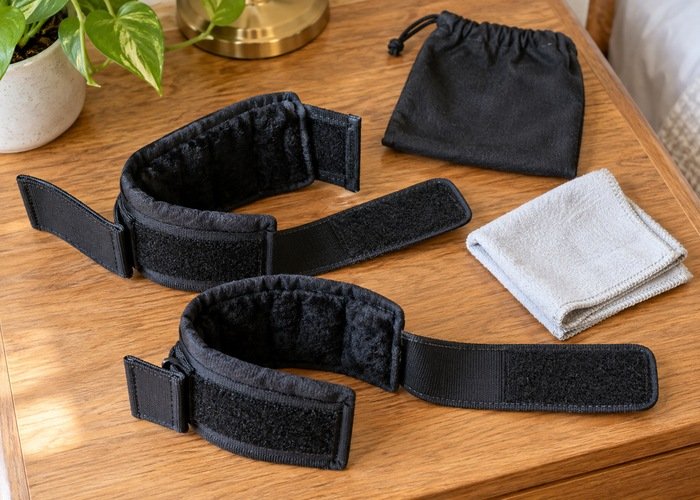
A restraint safety setup begins with a decision you can make before anything touches skin: can this product be opened immediately, without guesswork, and can everyone freely decide not to use it? If either answer is unclear, leave it unused. Attractive padding, substantial hardware, and a reassuring product photograph do not establish safe fit, reliable release, or suitability for a particular person.
This guide is for adults assessing consumer cuffs and restraint accessories. It covers buying information, unloaded inspection, release accessibility, material questions, and reasons to stop. It does not teach restraint positions, tightening methods, suspension, or installation of anchor points. No checklist removes the risks of restricting movement, and choosing an activity without restraints remains a valid option.
Before comparing a set in the KissSelf shop, obtain its actual instructions and identify every included component. A listing that shows several accessories together can make it difficult to tell which release belongs to which part. Keep the inspection simple: one item, its instructions, good light, and no person restrained while you work out how it functions.
Separate agreement from the equipment check
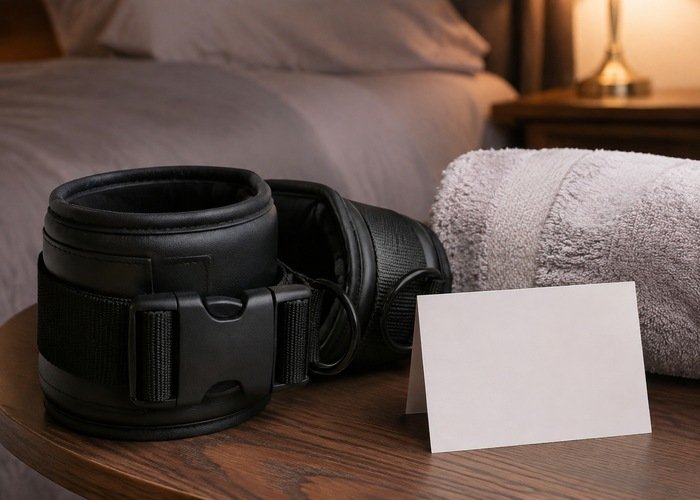
A working fastener cannot compensate for pressure to participate. Discuss the idea before opening the package, away from any expectation that a purchase must be justified. A person may agree to look at a product without agreeing to wear it. Agreement on a previous occasion does not settle what happens today, and purchasing the equipment together does not create an obligation.
NHS information about consent and sexual assault explains that a relationship is not consent and consent can be withdrawn. For this product decision, use that principle plainly: either adult can decline or stop, without bargaining. Silence, uncertainty, freezing, or an inability to respond is not permission to continue. Do not use restraints when alcohol, drugs, sleep, or another condition prevents clear, voluntary agreement.
Do not treat a special word as the only valid request to stop. Ordinary language, distress, and attempts to withdraw matter too. Agree that any uncertainty means stopping, not asking the other person to prove discomfort. Keep speech, observation, and immediate assistance available; this guide does not cover anything that restricts breathing, obscures responsiveness, or prevents a person from communicating.
Read the product information before judging its appearance
Look for a named manufacturer, an identifiable model, understandable instructions, intended use, material information, and a support contact. Check whether the information describes your exact version rather than a similar photograph. A newer buckle, different lining, or alternative connecting strap can change the care and release instructions even when the product name stays the same.
Separate statements about comfort from statements about limits. Words such as soft, secure, premium, and adjustable do not explain how a closure opens or establish an appropriate load. If an advertisement uses the word universal, ask what actual sizing and use restrictions accompany it. An unanswered question is a reason to pause the purchase, not permission to fill the gap with an online tip.
Keep a copy of the care directions and order details somewhere accessible. If the product later develops damage, that information makes a precise support request possible. Photographs can document a separated seam or cracked fastener without including anyone’s body. Avoid sending sensitive personal images when a photograph of the equipment alone will answer the seller’s question.
Understand what the release actually releases
Some sets have a closure around the cuff and a separate connector between accessories. Opening the connector may detach one item from another while leaving the cuff closed. Conversely, opening the cuff may not remove every other attached component. Trace these functions with the product empty on a table. Do not assume a visible clip is an emergency release for the whole arrangement.
Follow the manufacturer’s directions to open and close an unloaded item. You should be able to identify the correct control without force, searching through packaging, or improvising a tool. If the closure sticks, catches its lining, or works inconsistently, set the product aside. Repeated practice with a defective fastener does not repair the defect.
A spare key is not a substitute for an accessible release, and a phone-controlled feature should not be the only means of becoming free. For a beginner purchase, avoid equipment whose safe removal depends on a lock, an absent person, a charged battery, or network access. A claim that something can be cut in an emergency is not an adequate routine release plan either.
Never test whether a fastening will open under force by restraining someone and pulling against it. Unloaded inspection can expose obvious defects but cannot certify performance under load. Where instructions do not clearly explain the product’s limits, do not invent a home stress test. Ask the manufacturer or choose a simpler, nonrestrictive alternative.
Examine the surfaces that can contact skin
Open the cuff fully and look at both faces, folded edges, stitching, and any backing beneath hardware. A smooth outer face can conceal a rough seam inside. Check for exposed hook material, sharp edges, loose threads, cracked coating, and padding that has shifted away from a firm edge. Use light and visual inspection rather than dragging a questionable edge across skin.
Do not repair a new product with tape, glue, extra fabric, or a replacement fastener from a different set. These changes can obscure damage and alter fit or release. Keep a defective item unused while discussing a return or replacement. A seller’s suggestion that roughness will soften with wear should not override an obvious skin-contact defect.
Identify the lining and any metal that could touch skin, not just the material named in the headline. Our overview of intimate-product materials can help frame questions, but it is not evidence that a particular cuff contains a particular material. Product-specific disclosure matters, especially when someone already knows they react to a textile, coating, adhesive, or metal.
The NHS explains contact dermatitis as a reaction involving an irritant or allergen; persistent, recurrent, or severe symptoms need medical assessment. Padding does not guarantee that a product is suitable for sensitive skin. Do not use a new accessory over irritated or broken skin, and do not perform an improvised prolonged skin test to establish that an unknown material is safe.
Different accessories also need different questions. The separate guide to padded clamp accessories discusses their contact pads and adjustment hardware; it should not be treated as a cuff-fitting method. Keep advice attached to the product it describes. Similar-looking fabric or metal does not make the mechanisms interchangeable, and an experience with one accessory cannot establish suitability for another person’s body or another product.
Why adjustable does not mean suitable for everyone
An adjustment range describes the equipment, not a universal safe fit. The relevant person may have an injury, reduced sensation, a circulation concern, swelling, or another reason to avoid compression or restricted movement. If there is uncertainty about an individual health condition, ask a qualified clinician before use rather than relying on a seller’s reassurance.
No number of fingers beneath a strap can guarantee safety. Nor does the absence of a mark prove that nerves or circulation are unaffected. Avoid guides that offer one tightening rule or one wearing duration for every body and product. A timer may keep time accurately while saying nothing about whether an individual is safe.
Do not try to solve an oversized cuff by adding extra layers or solve an undersized cuff by forcing its last fastening point. Improvised padding can move, hide contact edges, or interfere with removal. If the published sizing information does not clearly suit the intended wearer, leave the item unused and ask about an appropriate alternative or return.
Anchor points are a separate safety question
An attractive bedframe, door handle, chair, or decorative ring is not evidence of a suitable anchor. Likewise, a product being sold with clips does not establish that surrounding furniture or fixtures can tolerate force. Do not infer load capacity from weight, appearance, or how solid something feels during an informal tug.
This guide does not provide anchoring instructions or recommend do-it-yourself attachments. If a proposed arrangement depends on furniture, installed hardware, or bearing body weight, do not proceed on the basis of this article. Suspension, neck restraint, chest compression, and any restriction of breathing are outside its scope and carry serious hazards.
Keep your own inspection focused on what you can establish without creating a restraint situation: the item is identifiable, its components match its instructions, its closure moves correctly while empty, and its surfaces show no obvious damage. Those findings are purchasing information, not a declaration that a complete setup is safe.
A practical accept, clarify, or reject table
| Observation | What it establishes | Next decision |
|---|---|---|
| Instructions name the exact model and explain opening | The release can be studied before use | Continue unloaded inspection; do not infer personal suitability |
| A clip detaches but the cuff remains closed | There are separate release functions | Clarify how every component is removed before considering use |
| Material or lining description is missing | Skin-contact information is incomplete | Ask for a specific answer; do not assume hypoallergenic construction |
| Frayed stitching, exposed edges, or a sticky closure | An observable product defect exists | Keep unused and request replacement or return |
| Removal requires an inaccessible key or device | Immediate independent removal is uncertain | Choose a different, nonrestrictive option |
| Any person is unsure about participating | Agreement is not established | Do not proceed, regardless of equipment condition |
Use the table to avoid a common purchasing mistake: treating several favorable observations as compensation for one serious unknown. Clear instructions do not cancel defective stitching. Comfortable-looking lining does not cancel an unreliable closure. Each unresolved essential question deserves its own answer, and some answers make returning the item the most sensible outcome.
Recognize stop signs without diagnosing them yourself
Pain, tingling, numbness, unusual coldness, discoloration, swelling, weakness, or difficulty moving are reasons to stop and remove the restriction immediately. Do not tighten, reposition, or restart the same activity to see whether the sensation changes. If release cannot be achieved immediately, seek emergency help rather than continuing to experiment with the equipment.
The NHS advice on pins and needles recommends medical review when symptoms persist or recur and cautions against self-diagnosis. A symptom disappearing does not validate the previous setup. Record what happened for a clinician if necessary, and do not use another attempt as a test of recovery.
Sudden severe pain deserves emergency assessment. The NHS compartment syndrome guidance describes a serious pressure-related condition and lists urgent warning signs. This does not mean every uncomfortable cuff causes that condition; it means severe symptoms should not be dismissed as ordinary discomfort. In the UK, call 999 or attend A&E for sudden severe pain; elsewhere use local emergency services.
For cuts, uncontrolled bleeding, loss of feeling around a wound, or difficulty moving require urgent assessment as described in the NHS cuts and grazes guidance. Do not continue using the item on injured skin. A shopping article cannot determine the cause or severity of an injury, and waiting for a seller’s reply is not a substitute for appropriate medical help.
Care starts with keeping the components identifiable
Follow the exact cleaning instructions for the lining, straps, and hardware. A washable textile component does not automatically make an assembled product suitable for soaking, boiling, bleach, or a washing machine. If directions are missing, obtain them before use. Do not borrow a cleaning method from a silicone product simply because both items are sold by the same shop.
After permitted cleaning, let the product dry as instructed and inspect it again. Look for a displaced lining, peeling surface, corrosion, or a closure that has changed behavior. Avoid masking a persistent smell with fragrance or covering a damaged patch. Changes that affect contact surfaces or release are reasons to stop using the item and consult the manufacturer.
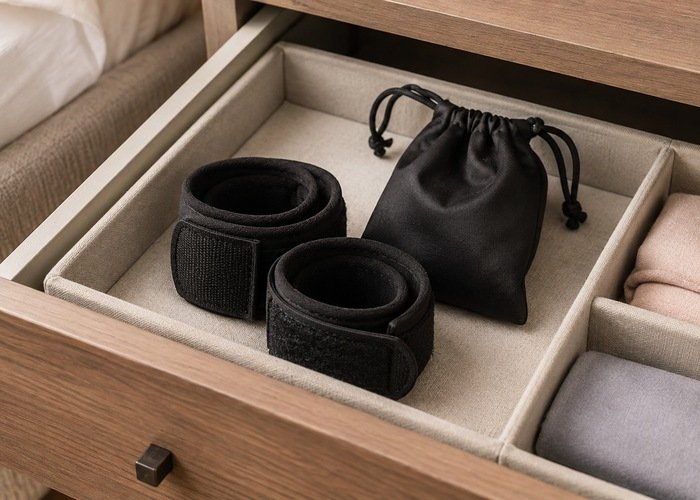
Keep each set together without putting pressure on its hardware. A separate pouch can make inspection easier, but a closed pouch is not a drying method. Our intimate-product storage guide covers general organization; retain the restraint manufacturer’s specific directions alongside the product. Store everything out of reach of children and pets.
Questions worth sending before placing an order
Ask the seller to identify the lining material, any exposed metal, the precise opening mechanism, and the cleaning method for the complete item. Request the actual instructions rather than a summary that it is easy to use. Clarify what the sizing measurement refers to and whether accessories shown in photographs are included. These are ordinary product questions, not requests for a personal safety guarantee.
Also ask how to report a defective fastening and which return conditions apply before opening or using the product. Keep hygiene restrictions distinct from the procedure for damaged goods; do not assume an advertising phrase answers either issue. Policies vary, so obtain the current written terms from the seller instead of relying on a general article about returns.
For a concrete hypothetical comparison, one listing may offer more components but omit its instructions, while another provides fewer parts and a clear unloaded release demonstration. That makes the second listing easier to evaluate, not automatically safe. If neither answers essential questions, buying neither is a complete decision. You do not need to choose the less unclear option.
Frequently asked questions
Does soft padding prevent injury?
No. Padding describes one part of the construction and may cover an edge, but it does not establish suitable pressure, safe movement restriction, or reliable removal. Inspect underneath and around it, obtain material information, and treat symptoms seriously. A thick lining cannot turn an unsuitable or damaged product into an appropriate one.
Can a beginner rely on a quick-release label?
Not by itself. Establish what opens, how it opens, and whether other components remain attached. Read the exact instructions and examine the empty product. If you cannot understand its release without improvisation, keep it unused. An advertising label does not demonstrate how equipment will behave in every circumstance.
Is there a universally safe time limit?
No universal time limit is established by this guide. A timer cannot account for personal health, pressure, movement, fit, or a defective closure. Never wait for a planned interval when discomfort, numbness, distress, or uncertainty appears. Stop immediately, and obtain medical help when symptoms or inability to release require it.
What should I do with a set after a problem?
Keep it out of use, deal with any health concern first, and document the equipment issue without recreating it on a person. Contact the manufacturer with the model and a clear description. Do not donate, resell, or quietly return a known unsafe item without disclosing the defect through the appropriate process.
A restraint safety setup is ultimately an exercise in recognizing limits: of agreement, of product information, and of what an unloaded inspection can prove. Keep release, skin-contact condition, and the ability to decline ahead of appearance or accessory count. Browse other KissSelf product-care guides for general ownership questions, but use qualified medical advice for personal symptoms and leave any unresolved restraint setup unused.