That beloved lace bralette you paid $80 for shouldn’t look shredded after a dozen washes — yet for most people, it does.
The uncomfortable truth: most laundry routines are actively destroying delicate lingerie, one cycle at a time. Understanding how to wash lingerie correctly starts with recognizing that the damage often begins long before the garment even touches water.
Hidden tension damage is the silent killer. Every spin cycle generates centrifugal force that pulls delicate lace fibers against drum paddles, hooks, and underwires. At high speeds, that tension exceeds what the fiber weave was designed to handle — and microscopic tears accumulate with every wash. By the time you notice fraying, the structural integrity is already compromised beyond recovery.
The “delicate” cycle myth compounds the problem. Machine manufacturers market the delicate setting as safe for fine fabrics, but the spin speed reduction is marginal in most standard home washers. The agitation pattern still stresses fine knit structures repeatedly, creating the same cumulative fiber breakage — just slightly slower. It’s not a solution; it’s a slower form of the same problem.
Fit and function suffer fastest in garments engineered with multi-layer or multi-functional design — pieces that combine molded foam, lace overlays, and stretch panels. Improper washing causes each layer to degrade at a different rate, destroying the precise shaping and support the garment was designed to deliver. According to The Lingerie Addict, over 80% of women are already wearing the wrong bra size — and distorted garments from poor washing make proper fit even harder to achieve.
The deeper issue, however, lies in the chemistry happening inside that drum — and what your detergent is actually doing to lace fibers at a molecular level.
The Chemistry of Care: Why Standard Detergents Fail
Most people searching for guidance on how to wash lace underwear focus entirely on technique — but the detergent sitting on your shelf may be doing more damage than any washing machine cycle.
The real culprit is chemistry. Standard laundry detergents are formulated for durability: removing ground-in stains from cotton, denim, and synthetic blends. To do that heavy lifting, they rely on protease enzymes — biological agents designed to break down protein-based matter. According to Martha Stewart Living, alcohol-free, enzyme-free liquid detergents are recommended for lace precisely because protease enzymes can degrade protein-based fibers found in silk-blend lace, degrading the structure from the inside out.
Fragrance is another hidden threat. Those “fresh linen” or “clean cotton” scents often signal the presence of synthetic surfactants and solvents that strip fiber coatings and accelerate elasticity loss. A pleasant smell shouldn’t come at the cost of fiber integrity.
Ingredients to avoid when choosing a lace-safe detergent:
- Protease enzymes — dissolve protein fibers in silk and silk-blend lace
- Amylase and lipase enzymes — secondary enzymes that compound fiber breakdown
- Alcohol-based solvents — strip natural fiber coatings and reduce suppleness
- Optical brighteners — chemical agents that weaken dye bonds and cause yellowing over time
- Heavy synthetic fragrances — often contain phthalates that stress delicate weave structures
Over time, repeated exposure to these ingredients causes chemical degradation — lace becomes brittle, loses its elasticity, and eventually snaps under the tension of normal wear or even gentle handling. What looks like a washing machine problem is, in many cases, a detergent problem.
Switching to an alcohol-free, enzyme-free liquid formula is one of the most impactful product changes you can make — before you even reconsider your washing technique, which we’ll cover next.
Mastering the Hand-Wash: Lingerie Care 101
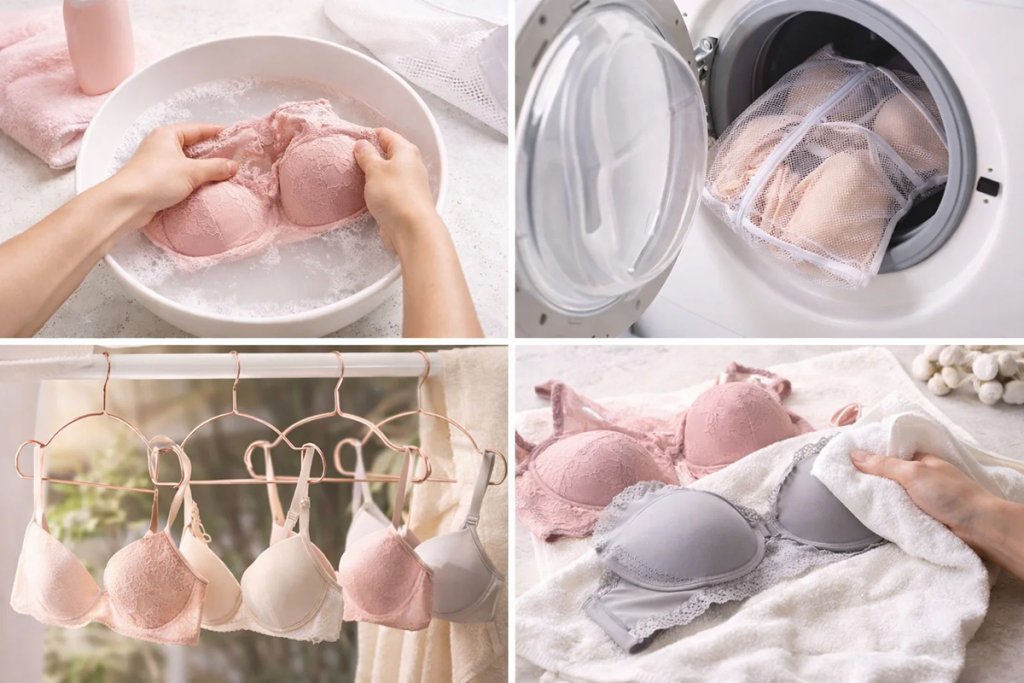
Hand-washing remains the single most reliable method for preserving lace lingerie — and temperature control is the first variable that separates care from damage.
Lukewarm water is non-negotiable. Water between 68°F and 86°F protects both the delicate lace structure and the elastic fibers woven through it. As Gwen Whiting, Co-founder of The Laundress, explains: “Heat is the enemy of elastic and lace; it breaks down the spandex fibers that provide the elasticity and resilience of high-end lingerie.” The same logic answers a common question — can you put lace in the dryer? Absolutely not. The heat alone makes a dryer one of the most destructive tools you can use on fine lace.
Follow these five steps every time you hand-wash lace lingerie:
- Fill a clean basin with lukewarm water and add a small amount of a pH-neutral, enzyme-free detergent.
- Submerge and soak for 10–15 minutes. Let the water do the work — agitation tears the weave, so keep your hands still.
- Treat stains gently by pressing a small amount of diluted detergent directly onto the spot, then leaving it to lift during the soak. Never rub or twist the fabric.
- Rinse thoroughly by lifting the garment and running fresh lukewarm water through it — repeat until the water runs completely clear to prevent soap buildup in intricate patterns.
- Press out excess water by laying the piece flat against the basin wall. Never wring.
Pro Tip: Roll the garment loosely inside a clean, dry towel and press gently — this removes most moisture without any stretching or distortion.
In practice, the “soak, don’t scrub” philosophy protects the integrity of every thread. For those who still prefer using a machine, the next section covers how to do it without sacrificing your lingerie’s lifespan.
The Machine Myth: How to Wash Lingerie in a Washing Machine Safely
Knowing how to wash lingerie in a washing machine safely comes down to one principle: eliminate every source of friction before the cycle even starts.
Hand-washing is ideal, but real life demands compromise. The machine can be used effectively if treated as a controlled environment. Skip any one of the following precautions, and you’re trading a few minutes of effort for a garment that won’t survive the month.
Using a mesh laundry bag is highly recommended. Lace catches on drum perforations, zipper teeth, and other fabrics with remarkable ease. Enclosing each piece in a fine-mesh bag creates a physical buffer that absorbs the machine’s movement instead of transferring it directly to delicate threads. One bag per garment — don’t stack multiple pieces together.
Sorting matters more than most people realize. Never wash lace alongside heavy fabrics like denim, towels, or even thick cotton tees. The weight differential creates uneven turbulence, and heavier items act like blunt instruments against fragile lace. According to Angela Friedman’s lingerie care guide, keeping delicates separated from everyday laundry is one of the most effective longevity strategies available.
Select the absolute lowest agitation setting — typically labeled “delicate,” “hand wash,” or “gentle.” High spin speeds stretch elastic and distort lace patterns permanently. As noted by Martha Stewart Living, using a specialized fine fabric wash alongside this setting prevents the chemical degradation that standard heavy-duty detergents cause.
⚠️ Warning: Never run a full drum load. The “half-load” rule exists because overcrowding crushes structured cups and compresses padding in ways that don’t bounce back after drying.
Once the cycle ends, resist the urge to wring anything out — that’s where the next step becomes critical.
The Salad Spinner Hack: A Revolution in Drying Lace
Wringing lace is the fastest way to ruin a garment’s shape — and the salad spinner method solves that problem with zero mechanical stress on delicate fibers.
Wringing seems intuitive after a soak, but the twisting force it applies to lace destroys the open-weave structure permanently. Elastic threads snap, underwire channels distort, and hand-stitched embellishments pull loose. In lingerie care 101, this is the mistake that voids everything you’ve done right in the wash.
The fix is centrifugal force. A kitchen salad spinner uses rapid rotation to push water outward through the basket’s holes — extracting moisture without applying any compressive or twisting pressure to the fabric. According to Better Homes & Gardens, the salad spinner technique is a highly effective, low-impact method for removing excess water from lace without wringing or distorting the garment.
How to do it in four steps:
- Lay the garment flat inside the spinner basket. Don’t bunch or fold — lay it as flat as the basket allows to distribute weight evenly.
- Add a clean cotton cloth on top to buffer contact between the lace and the basket wall.
- Spin for 10–15 seconds in short, controlled bursts. There’s no need to max out the speed.
- Remove immediately and transfer to a flat, clean surface for the final drying stage.
The real benefit: dramatically reduced drying time. Lace left waterlogged for hours becomes a breeding ground for mildew and odor — problems that embed into fibers and don’t fully wash out. Removing the bulk of moisture within seconds means your piece dries in a fraction of the time.
What happens after moisture removal matters just as much — and the next step is where most people make their biggest mistake.
Why the Dryer is the Graveyard of Great Lingerie
The dryer is the single most destructive force you can expose lingerie to — and the damage it causes is permanent, cumulative, and completely avoidable.
Elastic fiber degradation is the core issue. Spandex and elastane — the materials that give lace its stretch and recovery — are heat-sensitive at a molecular level. Dryer temperatures, even on low settings, repeatedly stress the polymer chains that give elastic its snap. In practice, what typically happens is a gradual but irreversible loss of tension: bands go limp, cups lose their shape, and underwires shift because the surrounding fabric no longer holds them in place. The garment hasn’t worn out from use — it’s been cooked into failure.
Heat and lace texture are equally incompatible. High temperatures cause the delicate nylon fibers in lace to contract unevenly, resulting in a scratchy, dull finish that no amount of fabric softener will reverse. The characteristic sheen that makes quality lace visually distinctive — that soft light-catching quality — is destroyed in the tumbling process, not gradually, but often after a single cycle.
“Air drying is the only recommended method for preserving the structural integrity of 3-in-1 functional garments or delicate lace.” — Gwen Whiting, Co-founder of The Laundress
To protect delicate lingerie during drying, flat-drying on a clean towel or mesh rack is the correct method. The “hanger stretch” — suspending a wet bra from its straps — transfers all the garment’s water weight directly onto the most vulnerable points, permanently distorting the strap attachment and cup placement.
Never do any of the following:
- Use the dryer on any heat setting, including “Delicate”
- Select “Air Fluff” — the tumbling action alone creates mechanical abrasion and pulls lace threads
- Hang bras by straps while wet
- Dry near direct heat sources like radiators or sunny windowsills
How you dry your lingerie is only half the equation — how you store it between wears matters just as much.
Storage Secrets: Maintaining Shape Between Wears
How you store lingerie matters just as much as how you wash it — and poor storage undoes every careful choice you’ve made, from knowing how to wash lace correctly to using the gentlest spin cycle.
- The nesting method for molded cups. Never fold one molded bra cup inside the other — that collapses the structure permanently. Instead, nest bras cup-to-cup in a single drawer row, keeping each underwire in its natural arc. This preserves the three-dimensional shape that gives a well-made bra its support and silhouette.
- Natural drawer fresheners over chemical liners. Lavender sachets or cedar blocks repel moths and moisture without releasing the harsh chemicals found in synthetic drawer liners. Those chemicals can degrade elastic and bleach delicate lace dyes over time. A small cedar block tucked beside your pieces costs under $10 and lasts for months.
- Keep lace away from sunlight. UV exposure fades dyes and weakens lace fibers far faster than most people expect — even indirect light through a window causes cumulative damage. Store lingerie in a closed drawer or a breathable fabric pouch rather than on an open shelf. Breathable storage options that allow air circulation also prevent the moisture buildup that encourages mildew.
Pro Tip — Rotate Your Pieces: Never wear the same lace garment two days in a row. Elastic needs 24–48 hours to recover its stretch after being worn. Consistent rotation across at least three to four pieces dramatically extends the lifespan of each one. As The Lingerie Addict notes, fit matters too — a garment that’s too tight puts constant tension on lace fibers, making them far more prone to tearing even before storage habits come into play.
Everything covered so far — washing, drying, and storing — comes together in one simple reference you can use every time.
The Bottom Line: Your Lingerie Care Cheat Sheet
Every lace piece you own will last longer when you follow four consistent habits — detergent choice, wash method, drying technique, and proper storage.
Think of this as your quick-reference guide, distilled from everything covered above:
- Always choose enzyme-free liquid detergent. Enzymatic cleaners — found in most standard laundry products — break down protein-based fibers. For lace, which often blends nylon and spandex, that means gradual structural damage with every wash. Reach for a detergent labeled “delicates” or “gentle formula” instead.
- Hand-wash first; machine-wash second. Hand-washing in cool water remains the gold standard. If a machine is necessary, a quality mesh laundry bag on the coldest, shortest cycle provides a reasonable alternative — never skip the bag.
- Never wring lace. Twisting wet lace distorts the weave immediately. Instead, use the salad spinner method or press pieces gently between two clean towels to remove excess moisture without stretching.
- Air dry flat, away from heat and sunlight. As The Laundress confirms, heat degrades the spandex fibers responsible for stretch and recovery — the very properties that make high-end lingerie fit well. Radiators, sunny windowsills, and dryers are all off-limits.
In practice, the entire routine takes less than five minutes and adds months — sometimes years — to the life of a quality piece. Consistent, low-effort care beats sporadic perfection every time. Of course, even dedicated care raises practical questions: how often is often enough, what household substitutes actually work, and what do you do when damage appears? Those everyday dilemmas are worth addressing directly.
Frequently Asked Questions About Lace Care
Proper lace care comes down to a few consistent habits — and knowing the answers to these common questions keeps your investment protected long-term.
How often should I wash my lace bras vs. underwear?
Lace underwear should be washed after every single wear, since direct skin contact transfers bacteria and oils quickly. Lace bras, however, can typically go two to three wears between washes — provided you rotate between multiple bras and allow each one to fully air out overnight before wearing again.
Can I use hair conditioner as a fabric softener for lace?
A small amount of hair conditioner diluted in cool water can work as a gentle fabric softener in a pinch, helping restore softness to stiff or slightly scratchy lace fibers. However, use it sparingly — a dime-sized amount per basin is plenty — and rinse thoroughly, since residue buildup can mat delicate lace patterns over time and attract more dirt between washes.
What should I do if my lace starts pilling?
Pilling is often caused by friction — either from machine washing, rough surfaces, or pairing lace with abrasive fabrics. Switch exclusively to hand washing, and use a small fabric shaver on low settings to gently remove existing pills without snagging the lace structure. Catching pilling early prevents irreversible damage to the weave.
Is it safe to use steam on lace lingerie?
Low-level garment steaming can safely relax wrinkles in lace without the direct heat damage that ironing causes. Hold the steamer at least three inches away and keep passes brief. One practical approach is using a clean salad spinner after hand washing — as noted by Better Homes & Gardens, centrifugal force helps extract moisture and reduces drying time, minimizing the need to steam altogether.