
A product can have an easy power button and still be difficult to own. When hands tire easily, check the whole routine: opening, charging, cleaning, drying, and putting it away.
Imagine finding a small vibrator with controls you understand, then discovering that its cap is difficult to remove or its charging connection requires a fiddly movement. The difficult part may happen before or after operation. A useful buying decision includes those less photogenic tasks.
This is a non-graphic ownership checklist for adults who want to think about hand comfort. It does not assess your strength, diagnose a condition, or identify a universally accessible model. Start with the tasks you need to manage and the manufacturer’s exact instructions, rather than assuming a compact shape makes everything easier.
Map the routine before comparing models
Write down an ordinary ownership cycle: retrieve the product, open its case, prepare it as instructed, operate and stop it, complete cleaning, allow drying, and store it. Add charging as a separate task. Mark where you would need a sustained grip, a pinch, a twist, or a precise connection.
Chelsea and Westminster Hospital’s hand-therapy guidance discusses avoiding tight or prolonged grip, balancing activity with rest, and arranging items within reach. These are general principles, not a test of intimate products. They support looking at the task and environment together instead of judging a photograph alone.
You do not need to prove you can manage a difficult movement repeatedly. Make a list of questions for the seller and, where appropriate, your occupational therapist. A task that remains uncertain can be a reason to postpone a purchase.
Include opening and retrieval
Ask how the outer case, protective cap, pouch, and any battery compartment open. Product photographs often show these parts already separated. Request a demonstration or a clear sequence that shows the starting position, the movement, and whether two hands are needed.
Distinguish a friction-fit cap from a threaded lid, and a zip pouch from a snap closure. These descriptions identify different tasks; none guarantees comfort. Ask about the actual dimensions and weight of everything you will handle, including a separate remote or case.
Consider the storage place you would actually use. Can you reach and lift the item without moving a stack of other belongings? A tiny pouch buried in a crowded drawer may be less practical than an identifiable case in an appropriate, easy-to-reach location. Privacy and access both belong in the plan.
Treat charging as its own task
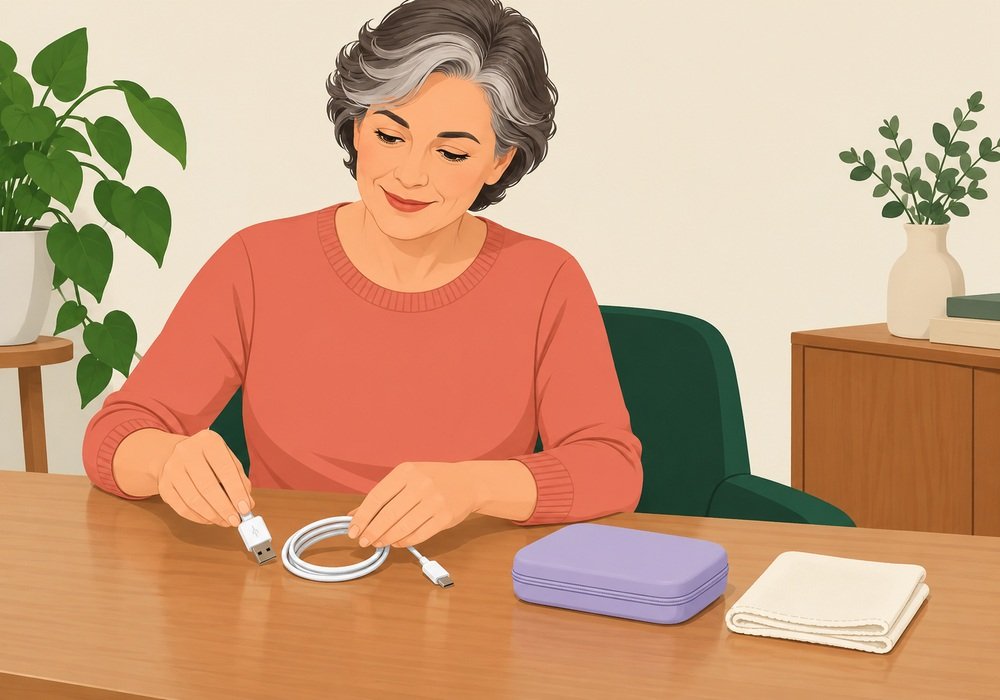
Before buying, ask how the specified cable connects and disconnects. Find out whether a cover must be opened, how the connector is oriented, and whether an indicator clearly confirms charging. Use the correct model’s documentation; a familiar-looking cable is not proof of compatibility.
Plan a suitable dry charging location that follows the instructions. Ask whether the product stays stable there without being held. Do not create a workaround by wedging a connector, adding tape over a port, using a different charger because it fits, or leaving equipment where liquid can reach it.
Keep operation questions separate from ownership questions. Our detailed guide to startup, settings, and stop controls covers the control sequence. Here, the question is whether the preparation and care tasks are manageable as well.
Read cleaning and drying instructions early
Ask for the complete care directions before checkout. Which parts may get wet? Must anything detach? Which products and methods are permitted? Can all required surfaces be reached without an uncomfortable grip? Do not substitute a quick wipe or an unapproved soak because the prescribed routine looks inconvenient.
Cleaning, drying, and storing are separate steps. Think about where a cleaned item can rest while drying as directed, and how you will move it afterward. A suitable clean surface should not require balancing the product precariously or keeping hold of it throughout the process.
A detachable design may add useful flexibility, but it also adds parts to identify, clean, dry, and reassemble. Check the whole sequence rather than assuming fewer or more pieces are always better. Ask the manufacturer about unclear steps; an attractive feature does not remove a care requirement.
For material and construction questions, the product construction checklist offers a separate reference. Continue to follow the exact model’s directions instead of carrying a cleaning method over from a different product.
Compare the whole task chain
| Task | Information to request | Reason to pause |
|---|---|---|
| Open and retrieve | Closure type, dimensions, weight, and demonstration | Required grip or movement remains unclear |
| Connect the charger | Exact cable, orientation, cover, and confirmation indicator | The plan depends on an improvised connection |
| Clean and dry | Permitted methods, detachable parts, and drying directions | You cannot complete the prescribed sequence |
| Store and repeat | Case, storage instructions, and access to the correct manual | The only available place is unsuitable or hard to reach |
For a hypothetical comparison, one product might have an appealing single button but a care routine you cannot comfortably complete. Another might have a less compact case but clearer instructions and manageable preparation. Compare the documented tasks rather than awarding the first product a pass on button count alone.
Use a listing as a starting point
The Lipstick Mini Travel Vibrator listing describes a lipstick-inspired form and one-button control. Those are useful details to identify. They do not establish the force needed to remove a cap, how easy a cable is to align, or whether the complete routine suits your hands.

If a demonstration is available, ask what can be shown without intimate contact and in accordance with the manufacturer’s directions. Check the retailer’s return conditions before ordering. Do not assume you can return an opened personal product after discovering that a task is difficult.
Plan assistance without losing choice
Arthritis Australia’s relationship guidance recognizes that pain and energy can affect intimacy and encourages communication. If another adult helps with a care task, discuss exactly what help you want. Assistance with charging or putting something away does not decide whether you want to use it.
The NHS explains occupational therapy as looking at everyday activities that are difficult and considering different ways to do them. Bring the task list and product instructions if you seek individual advice. General shopping suggestions cannot replace an assessment of your circumstances.

Use our conversation guide to explain your preferences, or the appointment preparation guide for a health discussion. Browse Sex Education for related reading. Waiting or choosing a different product is a valid result of a careful comparison.
Questions about hand comfort and care
Check the complete routine before relying on a convenient feature.
Does one-button control make a product accessible?
Not by itself. You still need to manage opening, charging, cleaning, drying, storage, and the documented stop action. Check the whole routine against your own requirements.
Can I skip a difficult cleaning step?
No. Follow the manufacturer’s prescribed care method. Ask for clarification or choose another product if that routine is not manageable; do not replace it with an unapproved shortcut.
Should I modify a cap or charging connector to make it easier?
Do not improvise a modification. Ask the manufacturer about approved options and seek individual advice where needed. A forced or altered connection is not a solution to an unclear task.
Can a partner help with care tasks?
Yes, if you want that help and agree on the particular task. Assistance with care does not decide whether you want to use a product, and you can change the arrangement.